
Sussex County Superior Court Overview
Delaware does not have a county district court. The state runs one unified judiciary, and the Delaware Judiciary structure puts Superior Court in the middle of the trial-court tier. In Sussex County, Superior Court sits in Georgetown at the historic Circle. It has original jurisdiction over criminal cases except equity matters, exclusive jurisdiction over felonies, and exclusive jurisdiction over nearly all drug offenses. On the civil side there is no monetary cap. A claim for one dollar or ten million dollars can be filed here if the case fits.
The court also takes appeals up from below. The Superior Court Sussex County page lists the local courthouse address, hours, parking notes, and the food and beverage rule that visitors often forget. Sussex Superior Court hears intermediate appeals from the Court of Common Pleas, from Family Court criminal matters, and from many state administrative agencies. Final judgments are appealable to the Supreme Court of Delaware.
A short lead-in image. The official Sussex location page is the best primary source for hours, suite numbers, and access notes.
The Delaware Judiciary's Sussex Superior Court location page lays out the suite, hours, parking lots, and food and drink rules in one place.
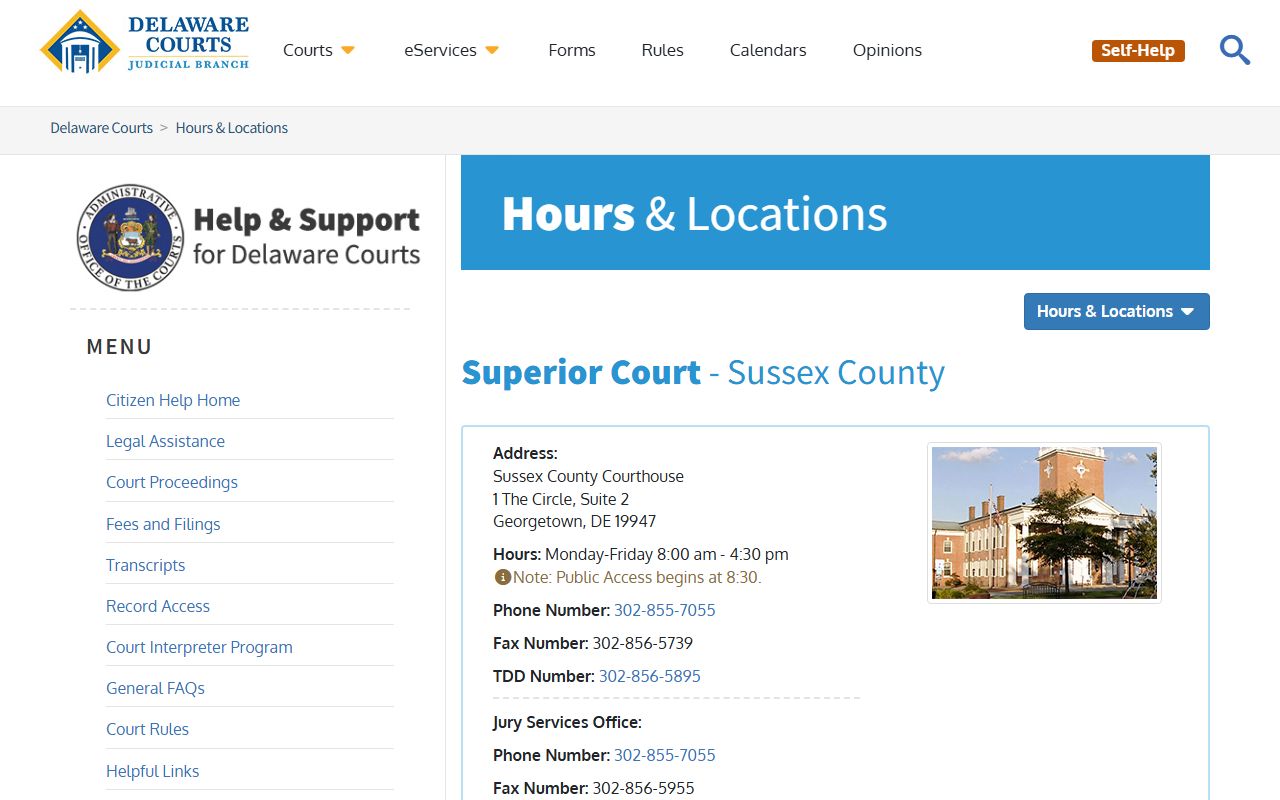
The same page also links the Courthouse Screening Policy, the jury services contact, and the public access start time of 8:30 a.m.
Sussex County Superior Court Address and Hours
Sussex Superior Court is at the Sussex County Courthouse, 1 The Circle, Suite 2, Georgetown, DE 19947. The main phone is 302-855-7055. The fax line is 302-856-5739. TDD service is at 302-856-5895. Office hours run Monday through Friday, 8:00 a.m. to 4:30 p.m. Public access to the building begins at 8:30 a.m., so visitors who arrive before then will be held outside. The court closes on state holidays observed by the Delaware Judiciary.
Sussex County Superior Court
Sussex County Courthouse
1 The Circle, Suite 2
Georgetown, DE 19947
302-855-7055
Fax: 302-856-5739 · TDD: 302-856-5895
Monday to Friday, 8:00 a.m. to 4:30 p.m.
Public access begins 8:30 a.m.
The same building houses the Court of Common Pleas in Suite 1, so visitors should check the door signs and floor directory before going in.
Internal Courthouse Rooms and Offices
The Sussex County Courthouse is older than most county buildings in the state, and many of its offices are tucked into specific rooms. Knowing the room number before arrival saves time at the screening line. The Superior Court page lists the working areas by room. Administration is in Room 214. The Prothonotary is in Room 214 as well. Bailiffs are in Room 203. Chambers are in Room 207. Court Reporters work out of Room 202. Jury Services is in Room 217. Investigative Services is not in the main courthouse at all; it is housed at 10 East Pine Street in Georgetown.
Jurors and civil filers often need the Prothonotary and Jury Services on the same day. The court groups Administration and the Prothonotary in one location to keep paper filings and case-management work close together. Anyone going for a criminal hearing should plan extra time to clear security before reaching Chambers or a courtroom.
Note: Investigative Services is at a separate address from the main courthouse, so visitors should not walk to The Circle if their appointment is on East Pine Street.
Delaware Court Hierarchy Serving Sussex County
The Delaware court system is a single statewide design, so Sussex County does not run numbered trial divisions. Instead, each state court has a Sussex branch or location. The table below maps the courts that hear Sussex matters, with the address and main phone for each.
| Court | Jurisdiction | Phone |
|---|---|---|
| Superior Court (Sussex) | Felony, civil with no monetary cap, appeals from lower courts and agencies | 302-855-7055 |
| Court of Common Pleas (Sussex) | Misdemeanors, civil up to $75,000, preliminary felony hearings | 302-858-5700 |
| Family Court (Sussex) | Domestic, juvenile, custody, support, protection | 302-855-7400 |
| Court of Chancery (Sussex) | Equity, trusts, estates, fiduciary, guardianship | 302-856-5777 |
| JP Court 3 (Georgetown) | Criminal, reduced 6 a.m. to midnight hours | 302-856-1445 |
| JP Court 14 (Georgetown) | Criminal and DUI | 302-856-4657 |
| JP Court 17 (Georgetown) | Civil | 302-856-1447 |
| Supreme Court of Delaware | Final appeals from Superior, Chancery, and Family Court | Statewide |
The same case may move through more than one of these courts on its way to a final ruling.
Superior Court vs Court of Common Pleas vs Justice of the Peace Court
Many users assume that the Superior Court hears every case. It does not. Delaware splits trial work across three statewide courts that overlap in some ways and diverge sharply in others. The comparison below shows the most common dividing lines.
| Superior Court | Court of Common Pleas | Justice of the Peace Court | |
|---|---|---|---|
| Civil Limit | None | Up to $75,000 | Up to $25,000 |
| Criminal Jurisdiction | Felonies and almost all drug offenses | Misdemeanors except certain drug and traffic offenses; preliminary felony hearings | Certain misdemeanors, most motor vehicle cases except felonies |
| Family Cases | No | No | No |
| Appeals Heard | From Common Pleas, Family Court criminal, agencies | From Justice of the Peace Court | None (entry-level court) |
| Sussex Location | 1 The Circle, Suite 2, Georgetown | 1 The Circle, Suite 1, Georgetown | Five Sussex locations |
The lower the court, the smaller the dollar limit and the lighter the criminal charges. Felony trials and complex civil suits do not belong in Justice of the Peace Court or Common Pleas. They start in Superior Court.
How a Case Moves Through the Sussex County System
A typical Sussex case does not jump straight to Superior Court. It steps up through the lower courts based on what type of matter it is. The flow below is the standard route for many criminal and civil cases that begin at the bottom of the pyramid.
Path: Justice of the Peace Court › Court of Common Pleas › Superior Court › Supreme Court of Delaware.
- A matter is filed or charged at the entry-level court. For traffic and small civil work, that is often Justice of the Peace Court. Preliminary felony hearings go to Common Pleas.
- Appeals from JP Court generally move to Court of Common Pleas, where the case is heard again or reviewed.
- Appeals from Common Pleas move to Superior Court, which acts as an intermediate appeals court for these matters.
- Felonies and high-stake civil suits are filed directly in Superior Court rather than passing through the lower tiers.
- Final Superior Court judgments are appealable to the Supreme Court of Delaware, the state's only court of last resort.
Family Court cases follow a different track. Civil and juvenile decisions from Family Court go up directly to the Supreme Court, while Family Court criminal matters route through Superior Court first.
Sussex County Superior Court Records and Case Search
Superior Court case dockets are searchable through Delaware CourtConnect, the State of Delaware Courts Judicial Case Database. CourtConnect lets a user search by person or business name, by case type, by judgment, or by docket report when the Case ID is known. The system is free and open to the public. It is not certified for official use. The Delaware Judiciary disclaimer is clear that data is provided as is and that email or web communication through the site does not count as filing or legal notice.
For full Sussex County Superior Court file content beyond docket entries, the Prothonotary in Room 214 handles in-person review and certified copy requests. Expungement petitions for cases that ended in Court of Common Pleas or JP Court are filed with the Superior Court Prothonotary. Forms, instructions, and an FAQ are linked from the Delaware Courts expungement page.
A second image with a working source link is helpful for users planning a record-clearing request. The Delaware Courts expungement page lays out the petition route and forms.
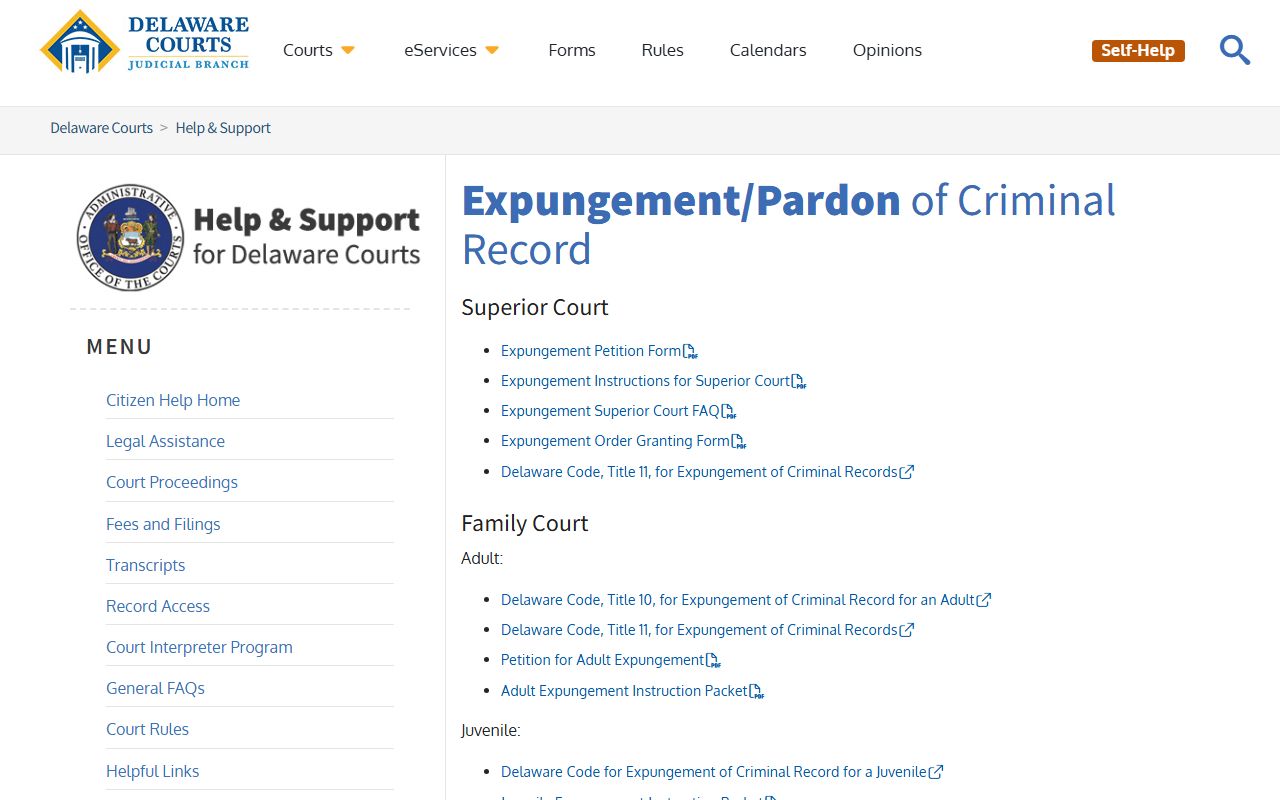
The expungement page also routes Family Court adult and juvenile petitions to the proper packet.
Parking, Screening, and Food Policy
Parking around the Sussex County Courthouse is tight. A small lot sits on East Pine and South Race Streets. Spaces closest to the courthouse have meters, and jurors who arrive early sometimes find a courthouse-lot space. Non-metered on-street parking is farther down South Race Street toward Union Cemetery. Court of Common Pleas users get similar guidance, with non-metered options farther down East Pine Street.
Security screening is required. The Superior Court page links a Courthouse Screening Policy. A Sussex-specific rule that surprises many visitors covers food and drinks. The public may not bring food or beverages into the courthouse. They must be eaten outside before entry. Limited exceptions cover staff with courthouse identification, government workers on official business, individuals with medical documentation, impaneled jurors, and case-by-case medical or child exceptions. Allowed items must be unopened and not in glass containers. No food or drink may enter any courtroom.
- Plan extra time to park, walk, and clear security before a hearing.
- Do not arrive before 8:30 a.m. expecting to enter; the lobby opens then.
- Leave snacks and drinks in the car or trash them outside.
- Bring identification and any required case documents.
- Check meter rates and time limits before walking away from the lot.
Note: Reasonable accommodations and sign language or language interpreters require at least five days of advance notice through the county or court contact.
Prosecution, Defense, and Court Records Access
Criminal cases in Sussex Superior Court are prosecuted by the Delaware Department of Justice, headed by the Attorney General. Delaware does not elect county district attorneys. The DOJ Criminal Division prosecutes from misdemeanors to murders statewide. In Sussex, the office is organized into a Felony Trial Unit, a Felony Screening Unit, and a Misdemeanor Trial Unit. The DOJ also runs the Victim and Witness Assistance Program that supports victims of crime through the case.
Indigent defendants are served by the Office of Defense Services, which has a Sussex office. ODS was established in 2015 and covers adults and youth charged with crimes. The agency also provides interpreters for legal representation free of charge.
Background checks based on certified criminal history are separate from CourtConnect dockets. Official criminal history records are governed by 11 Del. C. Chapter 85 and dissemination rules of the State Bureau of Identification. Adult expungement is governed by 11 Del. C. Chapter 85, Subchapter V.
The Delaware DOJ homepage identifies the Criminal Division and its county-level structure.

Victims and witnesses in Sussex can reach the DOJ Victim and Witness Program at 302-752-3263 for case status, safety planning, and compensation referrals.
Statutes and Authority
Sussex Superior Court operates under the Delaware Constitution and the court statutes in Title 10 of the Delaware Code. Title 10 lays out the structure of the trial courts and the boundary lines between Superior, Common Pleas, and the Justice of the Peace tier. The civil docket is influenced by Delaware Court of Common Pleas authority created under Title 10 Chapter 13, which sets the $75,000 limit on Common Pleas civil claims and leaves higher claims to Superior Court.
Public access to court information is shaped by court rules and by 29 Del. C. Chapter 100, Delaware FOIA, which governs county and executive records. Court files use the judiciary's own access rules rather than county FOIA. The CourtConnect disclaimer at the Delaware Judiciary site emphasizes that online data is not for official use.