
About Sussex County Family Court
Sussex County Family Court is a branch of the Delaware Family Court, a constitutional statewide court. The Sussex branch sits in a new building at 100 East Market Street in Georgetown. The court moved into that building in 2025, with a time capsule placed at the site on August 21, 2025. The doors open at 8:30 a.m., which is the same time the records room opens for the day. Family Court holds the bulk of the family-related case work for the county and serves the towns and rural areas across Sussex.
The court hears divorce and annulment matters under 13 Del. C. Chapter 15. It hears custody, support, paternity, and protection from abuse cases. The juvenile docket covers delinquency, dependency, and termination of parental rights work. Adoption cases also sit at Family Court. The court reaches across the whole county, and a Sussex family case rarely moves into Superior Court except on a criminal appeal or an unusual jurisdictional question.
Sussex County Family Court
100 East Market Street
Georgetown, DE 19947
302-855-7400
Director of Operations: 302-855-7478
Hours: Monday to Friday, 8:30 a.m. to 4:30 p.m.
What Sussex County Family Court Handles
Family Court has a wide jurisdiction that runs from a first paternity case to a final termination of parental rights. Most readers come to Sussex County Family Court records for one of a small set of matters. Knowing which type of file is involved saves time at the records room and on the phone.
- Divorce and annulment under Title 13 Chapter 15.
- Custody, visitation, and child support.
- Protection from abuse petitions and orders.
- Juvenile delinquency cases for youth under the felony age threshold.
- Dependency, neglect, and child welfare cases.
- Adoption and termination of parental rights.
- Juvenile expungement petitions under 10 Del. C. Chapter 9, Subchapter III.
Each case type has its own file structure. A divorce file holds the petition, response, financial disclosures, and the decree. A protection from abuse file holds the petition, the temporary order if one issued, and the final order. A juvenile delinquency file holds the petition, hearing notes, and the disposition order. Adoption files are sealed once the adoption is granted, and they sit under tight access rules.
What Family Court Handles vs. Does Not Handle
Many readers walk into Family Court with a case that belongs somewhere else. The chart below sorts the work by court so a reader does not end up in the wrong building.
| Family Court Handles | Family Court Does Not Handle |
|---|---|
| Divorce, custody, child support | Marriage license applications (Clerk of the Peace) |
| Protection from abuse cases | Most adult criminal cases (Superior Court or Common Pleas) |
| Juvenile delinquency | Adult felonies (Superior Court) |
| Adoption and termination of parental rights | Wills and estates (Register of Wills) |
| Paternity and parentage | Land records and deeds (Recorder of Deeds) |
| Juvenile expungement | Adult expungement of Superior Court convictions |
| Family-related contempt orders | Federal cases (U.S. District Court) |
Note: A reader who is not sure where a case belongs can call Family Court intake at 302-855-7400 to confirm the right court before traveling to Georgetown.
How to Review a Sussex Family Court File
Family Court records access is different from Superior Court. The Family Court records page sets a clear rule. A person may review a Family Court file at the location where the file is held, but all review takes place in the presence of court staff to prevent tampering. There is no free open online Family Court docket. Plan the visit before going.
- Confirm the file is in Sussex. A Family Court case from Kent or New Castle stays in that county's branch. Call 302-855-7400 to confirm.
- Pull together the case caption, the case number if known, and the date of the order or hearing of interest. Family Court staff often need the case number to pull the file.
- Go to 100 East Market Street in Georgetown. The doors open at 8:30 a.m.; the records room runs Monday to Friday, 8:30 a.m. to 4:30 p.m. The building closes for state and county holidays.
- Sign in at the front. Family Court allows cellular phones and personal electronic devices in the building subject to the Delaware Judiciary portable electronic devices policy. Cameras and recording may be restricted near hearings.
- Ask the records room for the file. A staff member supervises the review at the counter. Make notes on the spot. Pages can usually be copied for a fee.
- For sealed, juvenile, or adoption files, expect a written motion or party-status check before access. Some files are limited to parties, counsel, agencies, or court order.
The full Family Court records access page sets the policy framework for in-person review and the privacy charts that drive access decisions.
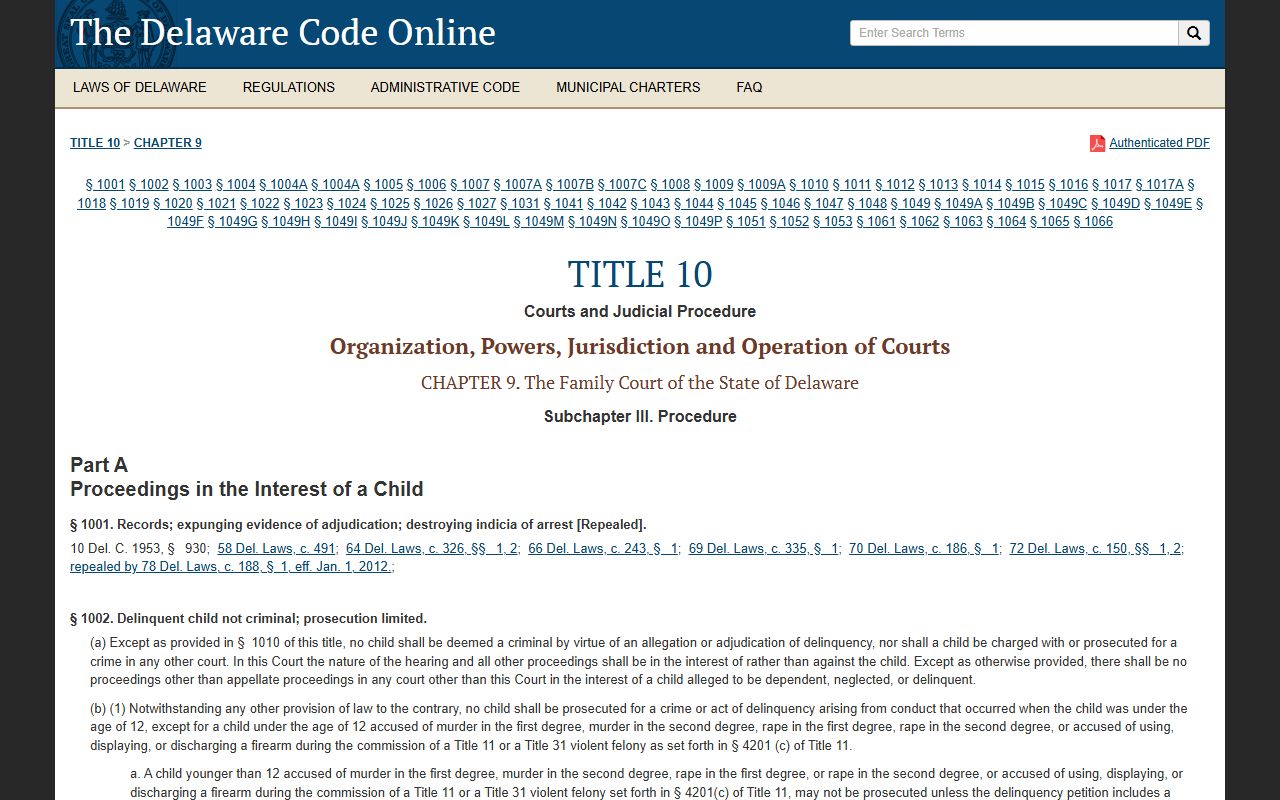
The juvenile expungement chapter sets the eligibility rules and forms that Family Court expects on a petition.
Family Court Terms Defined
Family Court paperwork uses a small set of standard terms. Knowing what each one means cuts down on confusion at the front counter and at hearings.
- Petitioner
- The person who starts the case by filing a petition. In a divorce, the petitioner is the spouse who files first.
- Respondent
- The party who answers the petition. The respondent has a set period to respond after service.
- Guardian ad litem
- An attorney or trained advocate the court appoints to speak for a child's interests in a contested case.
- Dependency
- A child welfare finding that a child needs court intervention because a parent cannot meet basic needs. The case may lead to services, placement, or further orders.
- Termination of parental rights
- A court order that ends the legal parent-child relationship. The order is permanent and usually clears the path for adoption.
- Protection from abuse
- A civil order that limits contact between a respondent and a person who has shown fear of harm. The order can include stay-away terms, no-contact terms, and temporary custody.
Sussex Family Court Divorce Records
A divorce case in Sussex sits with Family Court, not with the Marriage Bureau. The Marriage Bureau issues a license; Family Court hears the case that ends the marriage. Delaware divorce law sits in Title 13 Chapter 15. The file holds the petition, response, financial disclosures, mediation results if any, and the final decree.
Sussex County Family Court divorce records are reviewed at the records room under the same supervised-review rule. A party can ask for certified copies of the decree and of any related orders. A non-party who is not on the case usually needs a written reason to get more than basic public-facing information. Children's information and abuse allegations are commonly redacted in any released copy.
For the broader divorce and marriage-records framework, see the marriage and divorce records page.
Juvenile and Protection Cases
Juvenile and protection work is the most sensitive part of Family Court. Juvenile delinquency files cover offenses that would be crimes for an adult. The court can order probation, treatment, or commitment depending on the case. Dependency files cover children whose parents cannot meet basic needs. Adoption files close the legal parent-child relationship and create a new one. Each of those file types has tight access limits.
The Domestic Violence Advocacy Center Sussex supports protection-from-abuse petitioners. The center's local line is 302-856-5843. Advocates explain how a petition works, what a temporary order can do, and what to expect at the full hearing. They do not represent parties; that role goes to an attorney or to the Delaware Office of Defense Services for qualifying juvenile clients.
For juvenile expungement, Family Court is the filing court. The petition follows 10 Del. C. Chapter 9, Subchapter III. Delaware Courts has a centralized expungement page that lists the right court and the right form for each case path.
Note: A juvenile expungement is not automatic for every offense, and a pending charge or open case usually blocks the petition until the open matter is closed.
Appeals and Federal Overlap
Family Court civil and juvenile appeals generally go to the Supreme Court of Delaware. Family Court criminal appeals, where they exist, go to Superior Court. The path depends on the kind of order being appealed and the rules tied to that order.
Some Sussex family-related matters interact with federal courts. Bankruptcy can touch a support order. The U.S. Bankruptcy Court for the District of Delaware handles those federal pieces. Domestic abuse cases can also generate civil rights claims that move into federal court at times.
The Bankruptcy Court site explains how federal filings can intersect with state family orders, especially for support arrears.
An appeal from a state court matter that raises a federal question may move into the U.S. Court of Appeals for the Third Circuit after the state court process ends.
That site lists the federal appellate path that some family cases follow after the Supreme Court of Delaware has acted.
The New Sussex Family Court Building
The Sussex Family Court building at 100 East Market Street replaced earlier court space and brought the family work into a single, modern building. The building has ramp entrances and automatic doors and is set up for handicapped access. A reader who needs sign-language or language interpreter service should ask in advance through the court's interpreter request process. The county ADA contact is Brandy Nauman at 302-855-7779.
The Sussex Law Library is at the same address. The librarian is Margaret L. Naylor, reachable at 302-856-5483. The library is open to the public and the pro se community and is a useful resource for a self-represented party who needs to read a statute, a court rule, or a form before filing.
A time capsule was placed at the new Family Court site on August 21, 2025. The capsule is a small reminder that the move into the new building was a recent event for the Sussex bench and bar.