
What Probate Covers in Sussex County
Probate in Delaware is the process of proving a will and administering an estate. In Sussex County, routine probate sits with the Register of Wills. The current Register is Gregory Fuller. His office grants authority to the personal representative, makes sure the administration follows Delaware law, and handles the standard estate paperwork from opening to closing. The office files wills, opens estates, issues short certificates, accepts inventories and accountings, and closes the estate when the work is done. Delaware wills and estate law sits in Title 12 of the Delaware Code, with Chapter 1 covering wills and the later chapters covering administration.
One key point that trips up new readers: Sussex County does not have a court called the Probate Court. The Register of Wills is a county office, not a court. Contested matters, fiduciary disputes, trust questions, and guardianships sit with the Court of Chancery, the equity court that hears those matters statewide. Sussex Chancery has a courthouse at 34 The Circle in Georgetown. Both offices use the same general body of estate law, but they handle different sides of the work. Routine opening and closing of a will sits with the Register; a fight over a fiduciary or a request for a guardian goes to Chancery.
The Recorder of Deeds is a separate office and does not record wills. Marriage records sit with the Marriage Bureau. Anyone who wants a quick overview of how the Sussex offices around The Circle fit together can start with the marriage and divorce records page for the Marriage Bureau side and the Register of Wills page for the probate side.
Probate Terms Defined
Probate paperwork uses a small set of standard terms. The Register of Wills uses them on every estate. Knowing what they mean cuts down on calls back to the office and missed deadlines.
- Testator
- The person who made the will. The estate that flows from a testator's will is called a testate estate.
- Executor
- The person named in the will to carry out its terms. An executor is the personal representative for a testate estate.
- Intestate
- Dying without a valid will. Delaware law sets out who inherits and who can be appointed to administer the estate in that situation.
- Personal representative
- The general term for the person, executor or administrator, that the Register of Wills authorizes to act for the estate.
- Short certificate
- The Register of Wills document that proves the personal representative's authority. Banks, insurers, and transfer agents ask for short certificates before releasing assets.
- Guardianship
- A Court of Chancery proceeding to appoint a guardian for a minor or for an adult who cannot manage personal or financial affairs. Sussex Chancery has an emergency email for after-hours guardianship matters.
- Conservatorship
- In some Delaware contexts a conservator manages property for a protected person. Chancery handles those appointments under its equity authority.
How to Search Sussex County Probate Records
The Register of Wills does not run an open online docket search for estate files. The official process uses an Estate Search Request Form, not email. Many people try to email a decedent name and ask staff to dig through files; the office sends those requests back with the form. Plan to fill out the form or to visit in person.
- Identify the decedent name, the date of death if known, and the county where the person lived at death. Delaware law sends a will to the Register in the county of domicile.
- Request and fill out the Sussex Register of Wills Estate Search Request Form. The form is the official channel for searches; email name-only requests do not get processed.
- Submit the form to the Register of Wills, 5 E. Pine St., PO Box 743, Georgetown, DE 19947. Office phone is 302-855-7875 and fax is 302-853-5871.
- For an open estate, the personal representative or attorney can request a short certificate or copies of filings at the office. Appointments are required to open or close an estate.
- For a contested matter, trust dispute, or guardianship, contact the Court of Chancery at 34 The Circle, Georgetown, DE 19947, phone 302-856-5777. Chancery cases also appear in the statewide Delaware court database for many case types.
- For a sealed or restricted file, or a record protected by privacy rule, expect access limits. Some guardianship files are limited to parties, counsel, agencies, or court order.
Sussex Register of Wills Probate Steps
The Register of Wills publishes the basic probate sequence for Sussex estates. Each step has its own deadline and its own fee. Missing a step does not void the estate, but it can trigger follow-up notices from the office or, in some cases, removal of the personal representative.
- Deliver the original will to the Register of Wills within ten days after receiving notice of the maker's death, as required by Delaware law. Keep a copy.
- Call the Register of Wills at 302-855-7875 to schedule the opening. Bring the original will and a certified death certificate.
- If the will is not self-proved, the office may need witnesses to verify signatures. Handwriting witnesses or disinterested individuals may be needed if original witnesses are not available.
- If no next of kin steps in within 60 days from death, the Register may appoint another interested person as administrator.
- Receive Short Certificates at opening to allow the personal representative to conduct estate business.
- File the inventory within three months after the granting of letters. Cost is $15, collected at opening.
- File the accounting within one year of granting letters. Closing costs are 1.25% of net personal estate, plus $20 recording and indexing, plus $5 per release filed.
Note: The Register of Wills building locks at 4 p.m. and the office closes to the public at 3 p.m. on the last Monday of the month, so time visits with care.
Probate Offices in Sussex County
Two offices handle the bulk of Sussex County probate work. The Register of Wills is the routine estate-administration office. The Court of Chancery handles equity, fiduciary disputes, trusts, and guardianships. Both are in Georgetown but at different addresses.
Sussex County Register of Wills
5 E. Pine St., PO Box 743
Georgetown, DE 19947
302-855-7875
Fax: 302-853-5871
Hours: 8:30 a.m. to 4:30 p.m.; building locks 4 p.m.
Court of Chancery, Sussex
34 The Circle
Georgetown, DE 19947
302-856-5777
Emergency guardianship email: Chancery_Guardianship_Emergency_Filings@delaware.gov
The Chancery emergency email is for after-hours or holiday guardianship emergencies only. It is not for civil action communications, status checks, or routine filings. Routine filings go through the normal Chancery process.
Sussex Chancery's telephone directory page lists the offices and case-management contacts at the courthouse.
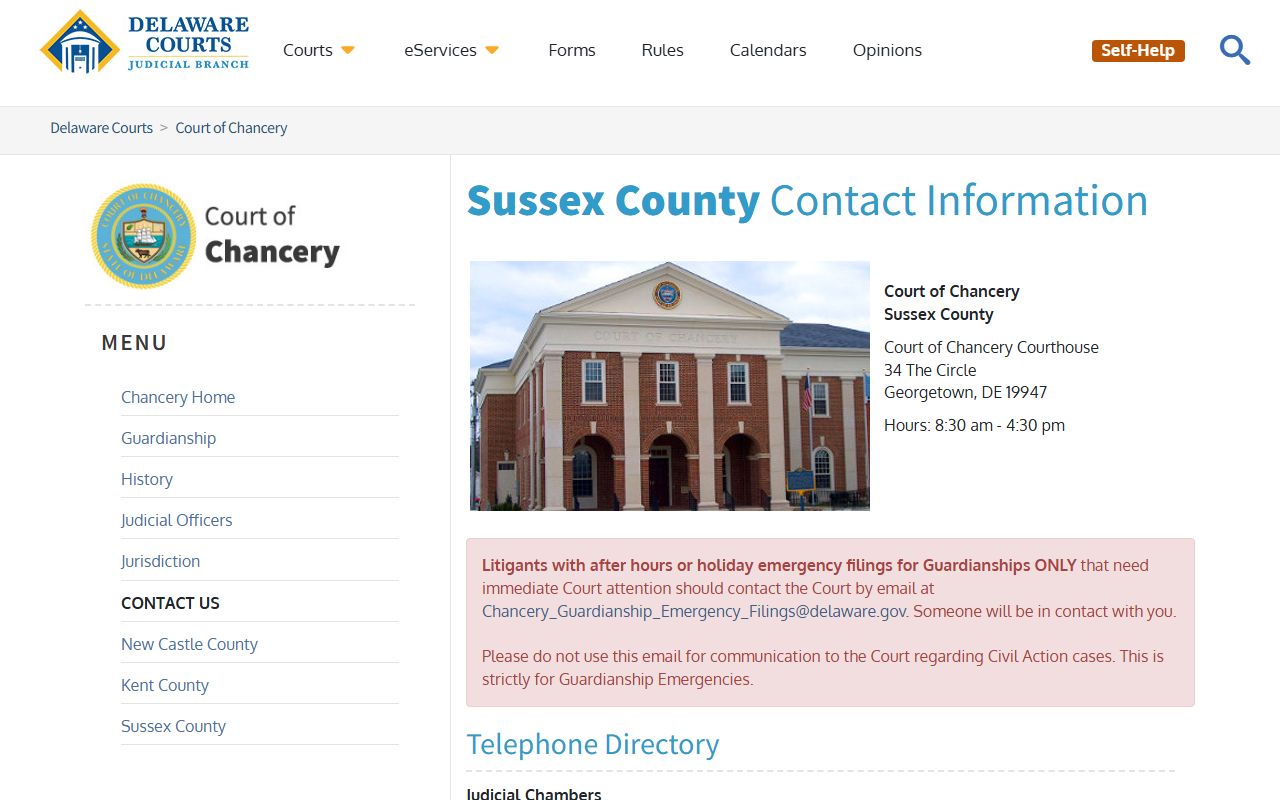
That directory is useful for guardianship petitioners, fiduciaries, and counsel who need to find the right Chancery deputy for the matter.
The same court has a separate location overview page that walks through the building, the parking, and the standard hours.
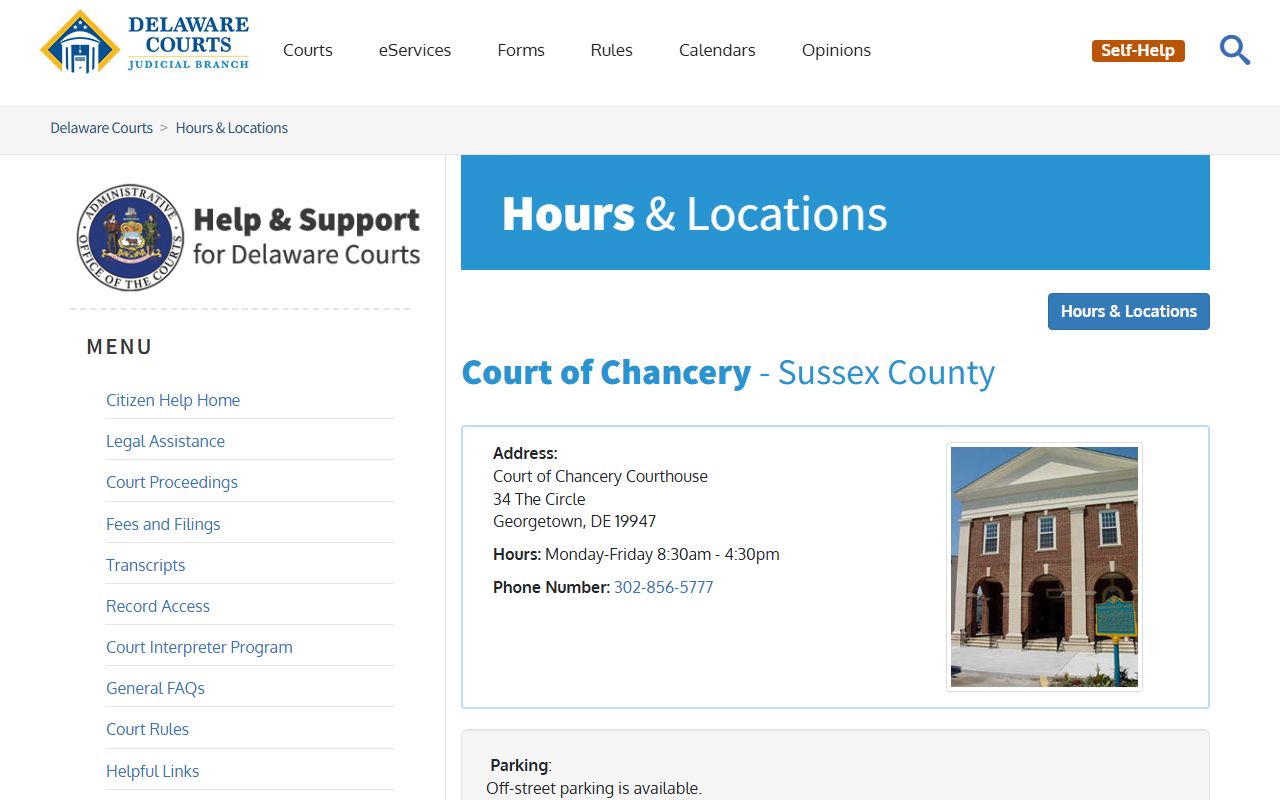
First-time Chancery filers in Sussex should read the location page before the first appearance.
Probate Filing Fees
Probate fees in Sussex County come from the Register of Wills. The captured probate steps page lists the figures below. The Register also publishes a fuller fee schedule for items not listed here, and Chancery has its own fee schedule for equity petitions.
| Item | Amount |
|---|---|
| Inventory filing | $15, collected at opening |
| Closing cost on net personal estate | 1.25% of net personal estate |
| Recording and indexing at closing | $20 |
| Per release filed at closing | $5 |
| Affidavit (no Delaware estate or inheritance tax due, relevant older periods) | $10 |
| Opening fee | Not fully captured in source pages; see Register's Various Fees page. |
The official Delaware Code text covering the work flows through several titles. The base authority is Title 12, with related Chancery jurisdiction in other titles.
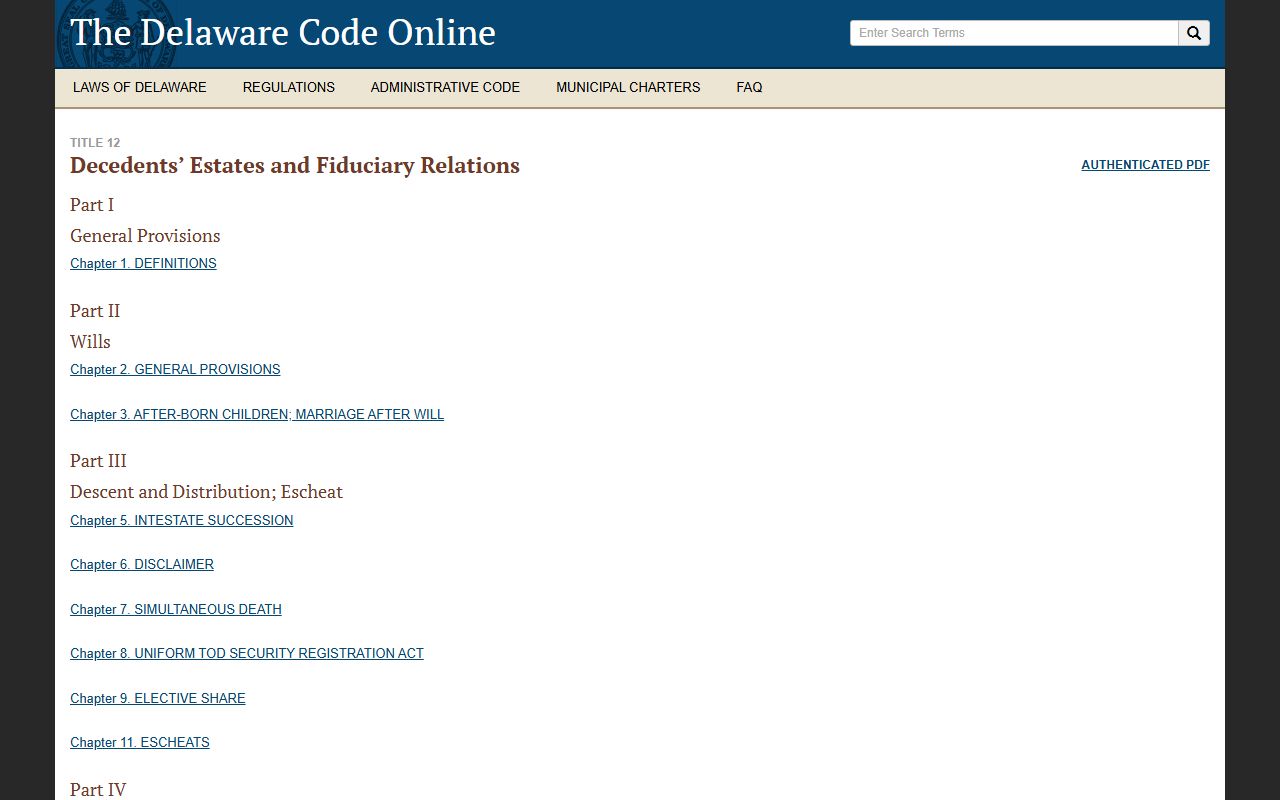
A read through Title 12 helps personal representatives understand what the Register expects at each stage.
What Sussex County Probate Records Show
A Sussex probate file is built up over the life of the estate. At opening, the file contains the original will if any, the death certificate reference, the petition to open, and the letters or short certificates that grant authority. As the estate moves, the file gains the inventory of assets, claims by creditors, sales or distributions of property, and tax filings. At closing, the file contains the accounting, the releases from beneficiaries, and the order or notation closing the estate.
For contested matters in Chancery, the file structure looks more like a normal civil court case. There is a petition, an answer, motions, scheduling orders, and a final order. Trust files and guardianship files have their own internal structures, with periodic reports from trustees or guardians and orders approving those reports.
Restricted Probate Records
Most routine probate filings at the Register of Wills are open to the public, since the will is a public filing once probated. Some material is restricted, though. Guardianship files for minors and for protected adults can be sealed or limited under Chancery rules and privacy practice. Trust files may have confidential schedules. Mental-health filings tied to a guardianship are generally treated as private. The Family Court probate-adjacent files for minors, such as adoption, are restricted by separate rule.
Public-access law generally treats records as accessible unless a statute, court rule, or privacy protection applies. For the broader public-records framework that touches county offices, see Sussex County public records.