
About the Sussex County Court of Chancery
Delaware's Court of Chancery has a long history as the state's equity court. The Sussex branch sits in a stand-alone courthouse at 34 The Circle in Georgetown, a short walk from the main county courthouse. The court hears equity cases for Sussex County and the cases that Delaware law sends to Chancery rather than to Superior Court. The Sussex branch shares the same jurisdictional grant as the rest of the court but draws its case load from the southern part of the state.
The Register in Chancery is the clerk of the court. The Register in Chancery main number for Sussex is 302-856-5777 and the fax is 302-856-5778. Office hours run Monday to Friday, 8:30 a.m. to 4:30 p.m. The court has a separate emergency email for after-hours and holiday guardianship matters, Chancery_Guardianship_Emergency_Filings@delaware.gov. That email is only for after-hours or holiday guardianship emergencies and is not the right channel for routine civil action communications.
Sussex County Court of Chancery
Court of Chancery Courthouse
34 The Circle
Georgetown, DE 19947
302-856-5777
Fax: 302-856-5778
Hours: Monday to Friday, 8:30 a.m. to 4:30 p.m.
Equity Jurisdiction in Sussex County
Equity is a different kind of law than damages-driven civil work. A Chancery case asks the court for an order: do this, stop doing that, account for the trust, appoint a guardian, set aside a deed, or settle a fiduciary fight. Chancery generally does not award money damages as a primary remedy, though it can award money damages when those damages are tied to an equitable claim. The Delaware Courts overview lists the kinds of disputes that Chancery hears.
- Corporate disputes, including derivative actions and shareholder claims.
- Trust administration, including trustee duties and accountings.
- Estate equity questions tied to a will or fiduciary.
- Guardianship of minors and of adults who cannot manage personal or financial affairs.
- Land title and real property disputes, including specific performance on a contract for the sale of land.
- Commercial and contractual matters that need an equitable remedy.
- Other fiduciary matters by statute or rule.
A Sussex equity case may begin as a routine guardianship petition or as a complex trust accounting that has dragged on for years. The Sussex branch handles both. Cases that need urgent guardianship action on a holiday or after hours use the dedicated emergency email above.
Court of Chancery vs Superior Court
The choice between Chancery and Superior Court is the first big procedural call in many Delaware disputes. The chart below sorts the work by court so a filer or a researcher does not end up at the wrong courthouse.
| Issue | Court of Chancery | Superior Court |
|---|---|---|
| Primary remedy | Equity: orders, injunctions, specific performance, accountings | Money damages, criminal sentence, statutory remedies |
| Money damages | Only when tied to equitable claim | No monetary maximum |
| Jury | No jury in equity | Jury available in many civil and criminal cases |
| Trusts, fiduciaries, guardianships | Yes | No |
| Corporate law | Yes | Limited |
| Felony cases | No | Exclusive jurisdiction over felonies |
| Appeals | To Supreme Court of Delaware | To Supreme Court of Delaware |
Note: A filer who is unsure whether a matter is equity or damages should read the Delaware Courts overview and, in close cases, consult counsel before filing.
How to Search Chancery Cases on CourtConnect
Delaware CourtConnect is the statewide judicial case database. Chancery dockets show up on CourtConnect alongside Superior, Common Pleas, JP, and Family Court matters. The portal is a docket and case information system; it is not a source of certified or official documents. Certified copies and many full filings still go through the Register in Chancery.
- Open the CourtConnect landing page and read the disclaimer. The data is provided "as is" and is not for official use.
- Choose the person, business, or case type search if no case number is in hand. Last name or company name is the required field.
- For Sussex Chancery work, narrow by case type. Useful Chancery codes include 2A for civil actions, 2G for guardianships, 2T for trusts, and 2M for miscellaneous matters.
- Add a filing date range in DD-MON-YYYY format if known. The month is a three-letter abbreviation, not a number.
- Review the results and note the case ID. The case ID is the key to the rest of the system.
- Use the docket report with the exact case ID to pull the docket. Optional start and end dates filter the docket entries.
- For documents beyond docket-level summary, call the Register in Chancery at 302-856-5777 to request a copy or to confirm sealing status.
CourtConnect's official-use limit matters. The Delaware Judiciary disclaimer says no email or internet communication through the site constitutes filing or legal notice and commercial use of the data is strictly prohibited.
Chancery Case Types Used in Sussex
CourtConnect uses short case type codes. The Chancery codes that come up most often on Sussex matters are listed below. Knowing the code helps narrow a search and pull the right kind of docket.
| Code | Case Type | Common Subject |
|---|---|---|
| 2A | Civil Actions | Equity civil claims, including injunctions and specific performance. |
| 2G | Guardianships | Adult and minor guardianship petitions and reviews. |
| 2T | Trusts | Trust administration, accountings, and fiduciary work. |
| 2M | Miscellaneous | Other Chancery matters that do not fit a standard label. |
| 2D | Technology Dispute Mediation | Technology disputes processed through Chancery mediation. |
| JA | Chancery Court Judgment | Recorded judgments from Chancery matters. |
Land-title cases often run alongside the work of the Recorder of Deeds because the underlying deed lives in the recorded land records, while the dispute itself sits in Chancery.
Probate and Estate Overlap
Chancery and the Register of Wills share the estate world. The Register handles routine estate administration, files wills, and grants letters or short certificates. Chancery handles the contested side: fiduciary disputes, trust questions, will contests with equitable claims, and guardianships. A reader who needs to open or close an estate goes to the Register of Wills; a reader who needs to remove a trustee or to ask for an accounting may end up in Chancery.
The Sussex Register of Wills page is the right starting point for routine estate work. The official record for a contested matter is the Chancery docket, with copies through the Register in Chancery. Delaware estate law lives at 12 Del. C. Chapter 1 for wills and Chapter 15 for Register of Wills authority and estate administration.
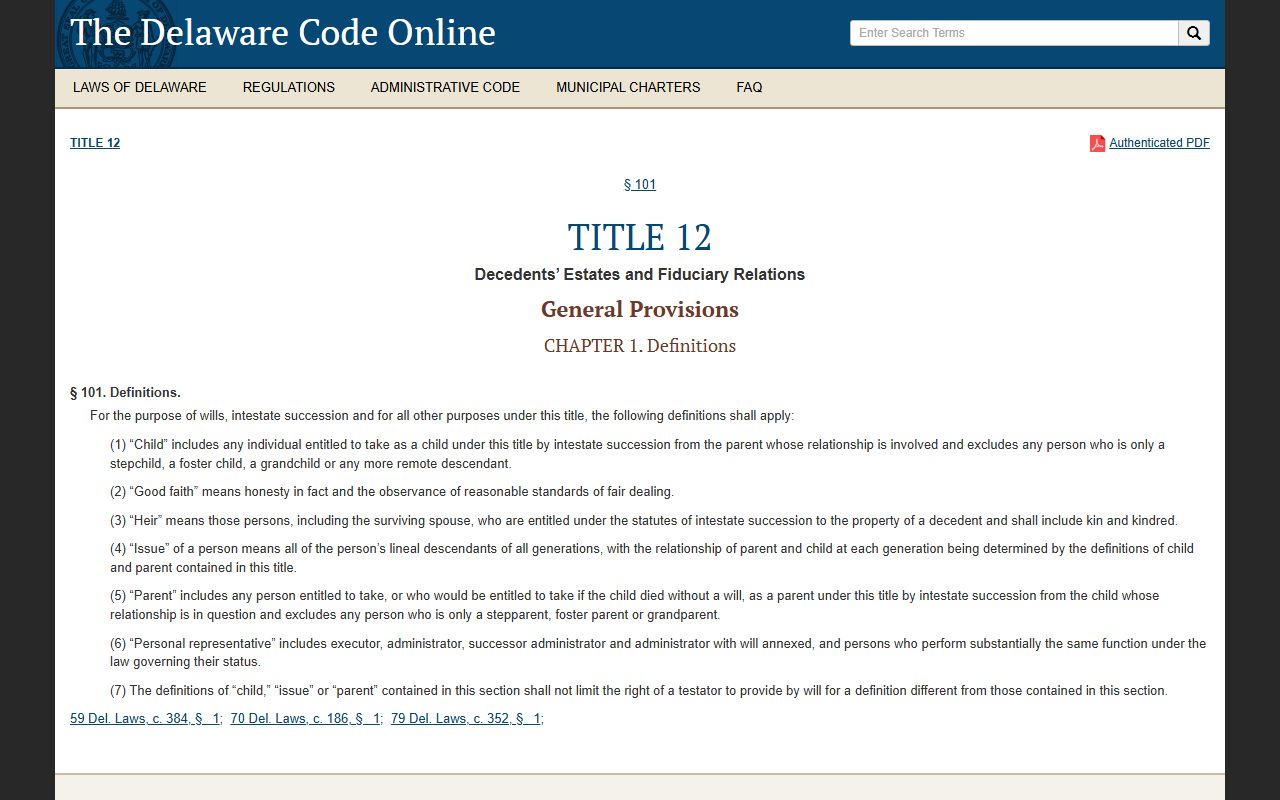
The wills statutes set out what counts as a valid will and what duties the personal representative owes to the estate.
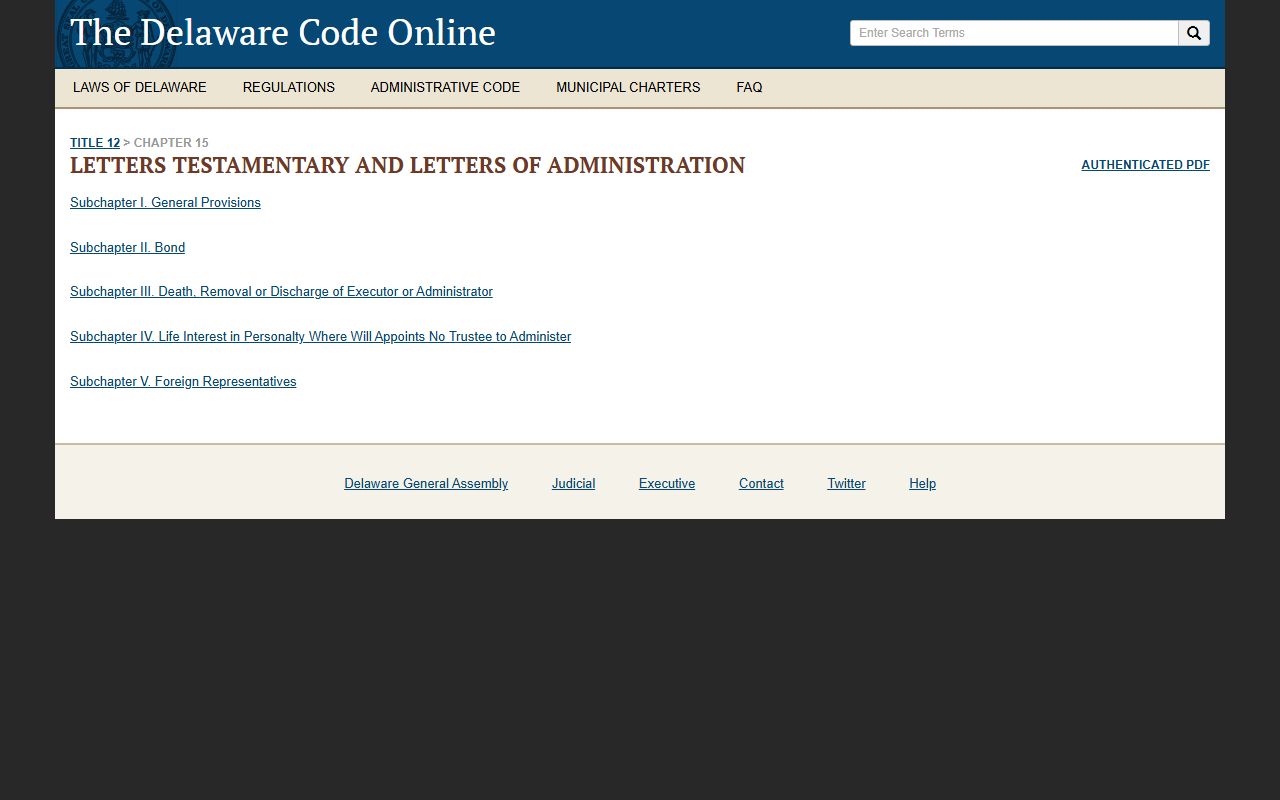
Chapter 15 covers the estate-administration framework that the Register applies and that Chancery enforces when a dispute crosses into equity.
Land Title and Recorded Deeds
Title disputes are a regular part of Sussex Chancery work. A specific performance claim on a contract for the sale of land, a quiet title action, an easement fight, or a partition case can all end up at Chancery. The Recorder of Deeds maintains the public land records that the Chancery case argues about. The official online portal for recorded land documents is the Sussex County online deeds search.
That portal returns the recorded deeds, mortgages, and releases that often form the document trail for a Chancery title case.
Appeals from the Sussex Chancery Court
Appeals from a final order of the Court of Chancery go directly to the Supreme Court of Delaware. There is no intermediate appellate court. A Sussex Chancery decision that someone wants to challenge moves to Dover, where the Supreme Court sits. The Supreme Court of Delaware is the only appellate court of last resort in the state and handles the appeals from Chancery, Superior Court, and Family Court civil and juvenile matters.
The appeal must be filed within the time the rules set for the kind of order being appealed. A late appeal is usually fatal. Counsel handles the appellate briefing and oral argument for most contested Chancery matters.
Filing and Visit Tips
The Sussex Chancery courthouse at 34 The Circle is small and central. The building is separate from the main Sussex County Courthouse at 1 The Circle, which holds Superior Court and Court of Common Pleas. A first-time visitor should plan for security screening and should arrive a few minutes before any hearing.
For routine civil filings, the Register in Chancery is the place to file. For after-hours or holiday guardianship emergencies, the Chancery_Guardianship_Emergency_Filings@delaware.gov address is the right channel. That email exists for true emergencies and should not be used for routine civil action communications, status checks, or copy requests. Routine civil action communication goes through the normal Chancery process.
The Sussex Chancery telephone directory lists the deputies and case-management contacts who staff the courthouse.
Note: Walk-in copy requests are easier when the case ID is in hand; staff can pull a file more quickly when the docket number is provided up front.
Public Access and Sealed Files
Chancery files follow Delaware Judiciary access rules. Most filed civil pleadings are open at the courthouse for review and for copy. Sealed material, confidential trade-secret schedules, certain trust documents, and guardianship records for minors and protected adults sit under tight access limits. A non-party who wants a copy of a sealed paper usually needs a written motion and a court order. Delaware FOIA at 29 Del. C. Chapter 100 covers county and state agency records but is not the access rule for state court files.
The Register in Chancery is the right office for a copy request that is not blocked by a seal. For a sealed item, expect to file a motion through counsel or in person and to wait for a ruling. Public access to a sealed Chancery file is the exception, not the rule.