
About the Sussex County Recorder of Deeds
The Recorder of Deeds is a county office headed by an elected Recorder. The current Recorder is Alexandra Reed Baker. The office's stated mission is to correctly record and index documents, respond to requests, collect and account for fees and taxes, and train employees. The office is in the Sussex County Administrative Office Building at 2 The Circle in Georgetown, the same building that holds the Marriage Bureau and the main county administrative offices.
The work is recording, not adjudication. The Recorder does not decide who owns a parcel and does not settle a title dispute. The office records the document, indexes it, and makes it part of the public land record. A challenge to a recorded document goes to the Court of Chancery for equity work or to Superior Court for damages claims. The recorded land record is the document trail that a court case argues about.
Sussex County Recorder of Deeds
Recorder: Alexandra Reed Baker
2 The Circle, PO Box 827
Georgetown, DE 19947
302-855-7785
Fax: 302-855-7787
Email: deeds@sussexcountyde.gov
Hours: Monday to Friday, 8:30 a.m. to 4:30 p.m.; recording window closes at 4 p.m.
What the Recorder Records in Sussex County
The Recorder's office handles a wide set of recorded instruments. Most are tied to a parcel of land or to a debt secured by land. A reader who needs a deed for a sale, a mortgage for a refinance, or a release for a paid-off mortgage starts with the Recorder.
- Deeds, including warranty deeds, special warranty deeds, and quitclaim deeds.
- Mortgages and related security instruments.
- Mortgage satisfactions and releases.
- Easements, rights of way, and grants of access.
- Restrictive covenants and declarations.
- Powers of attorney for real estate transactions.
- Plats and plans where recording is required.
Each instrument is recorded under a book and page or an instrument number and then indexed by the parties' names and, where used, the parcel reference. The index is the key to finding a specific document later. A reader who has only a name can pull a list of recorded instruments for that name and work from there.
Sussex County Online Deeds Search
The official online portal for recorded land documents is at deeds.sussexcountyde.gov. The portal runs on the Landmark Web Official Records Search platform. The portal returns search results for recorded deeds, mortgages, releases, and other instruments. The search-field set on the portal includes name, date range, document type, and recorded instrument identifiers. Exact field labels and the full set of fields can change as the portal is updated; the basic name and date-range search remains the most reliable path.
The portal landing page is the entry point for any name or instrument search. Field labels on the live portal should be checked at the time of search because the captured view shows only a partial set of fields.
The portal returns the index hit and, in most cases, a viewable image of the recorded document. A reader can print the image or save it. A certified copy of a recorded document, where one is needed for legal use, goes through the office at 2 The Circle at the recording window or by mail.
How to Search Sussex County Land Records
A land-records search at the Recorder follows a standard pattern. The pattern works for an owner check, a lien check, or a chain-of-title look-back. The basic flow runs from the name or parcel to the recorded document and then back to the index for related filings.
- Open the Sussex online deeds portal at deeds.sussexcountyde.gov.
- Enter the party name. Last name first usually returns the cleanest result. Try variant spellings if the first search returns no hit.
- Set a date range that covers the period of interest. A purchase from a known year benefits from a narrow range; a chain-of-title look-back needs a wider range.
- Select a document type if known. Deeds, mortgages, and releases are the most common types. Leave the type open to capture all recorded instruments for a name.
- Review the index hits. Click into a hit to see the document image and the recording details, including book and page or instrument number.
- For a certified copy or for a recorded instrument that is not viewable online, call the office at 302-855-7785 or email deeds@sussexcountyde.gov. The recording window closes at 4 p.m. for in-person visits.
- For a title opinion or a legal use, work with a Delaware title company or counsel. The Recorder records and indexes; it does not give title opinions.
Note: The portal capture in research notes was partial, so a fresh look at the live portal is the right way to confirm the current field list before relying on a search result for a closing or a legal filing.
Recorder of Deeds Records vs Court Judgments and Liens
The Recorder's office and the courts handle different kinds of public records. The chart below sorts the work so a reader does not look for a court judgment in the deeds portal or for a deed in CourtConnect.
| Topic | Recorder of Deeds | Court Records |
|---|---|---|
| Office | Sussex County Recorder, 2 The Circle | Delaware Judiciary, Sussex courts in Georgetown |
| Main record | Recorded land documents | Civil and criminal court files |
| Document types | Deeds, mortgages, releases, easements | Complaints, judgments, liens, orders |
| Online portal | deeds.sussexcountyde.gov | CourtConnect at the Delaware Courts site |
| Certified copies | Recorder of Deeds office | Court clerk or Prothonotary |
| Authority | Records and indexes; no rulings | Decides cases and issues orders |
A mortgage foreclosure case shows the overlap. The mortgage itself is recorded with the Recorder. The foreclosure case is filed with Superior Court through the Prothonotary. The judgment in the foreclosure case is entered on the court docket and can also be recorded in the land records. A sheriff sale follows from the court judgment, with the Sussex County Sheriff conducting the sale.
How Recorded Documents Show Up in Court Cases
Recorded land documents show up regularly in court cases. A title dispute relies on the chain of recorded deeds. A mortgage foreclosure relies on the recorded mortgage. A lien claim relies on the recorded mechanic's lien or judgment lien. A property tax case relies on tax monitions and recorded liens. Even a probate matter can involve recorded documents when an estate holds real estate that has to pass under the will or by intestacy.
A Sussex County civil case that turns on a deed will often cite the recording book and page or the instrument number. A reader who is following a case can pull the recorded document from the Recorder's portal to see the actual text. The official Delaware Courts FOIA portal is at sussexcountyde.mycusthelp.com for county administrative records that do not live in the deeds portal.
The county FOIA portal is the right place for non-court county records when the request goes beyond the deeds portal.
Visiting the Sussex Recorder of Deeds
The Recorder's office is in the Administrative Office Building at 2 The Circle in Georgetown. The building is on the same block as the main Sussex County Courthouse at 1 The Circle and a short walk from the Court of Chancery at 34 The Circle and the Sussex Register of Wills annex at 5 E. Pine St. A visitor who needs deeds and an estate matter on the same day can usually cover both with a short walk.
Office hours run Monday to Friday, 8:30 a.m. to 4:30 p.m. The recording window closes at 4 p.m., so a document that needs same-day recording must be at the window before 4 p.m. The office accepts mail filings as well; the mailing address is PO Box 827, Georgetown, DE 19947.
Parking in Georgetown follows the standard courthouse pattern. A small lot sits on East Pine and South Race Streets. Metered spaces sit closer to the buildings, and non-metered spaces sit farther down the same streets toward Union Cemetery. Confirm meter rules before parking for a long visit.
Note: Recording fees and copy fees are set by office policy and Delaware law; call 302-855-7785 to confirm a current fee before sending a document or a copy request.
Estates, Deeds, and the Probate Side
A Sussex estate that holds real estate touches both offices. The Sussex Register of Wills handles the estate administration, including any deeds that need to issue from the estate to a beneficiary or to a buyer. The Recorder of Deeds records the new deed in the land records once the estate signs it. The two offices work in sequence on a sale or transfer that comes out of an estate.
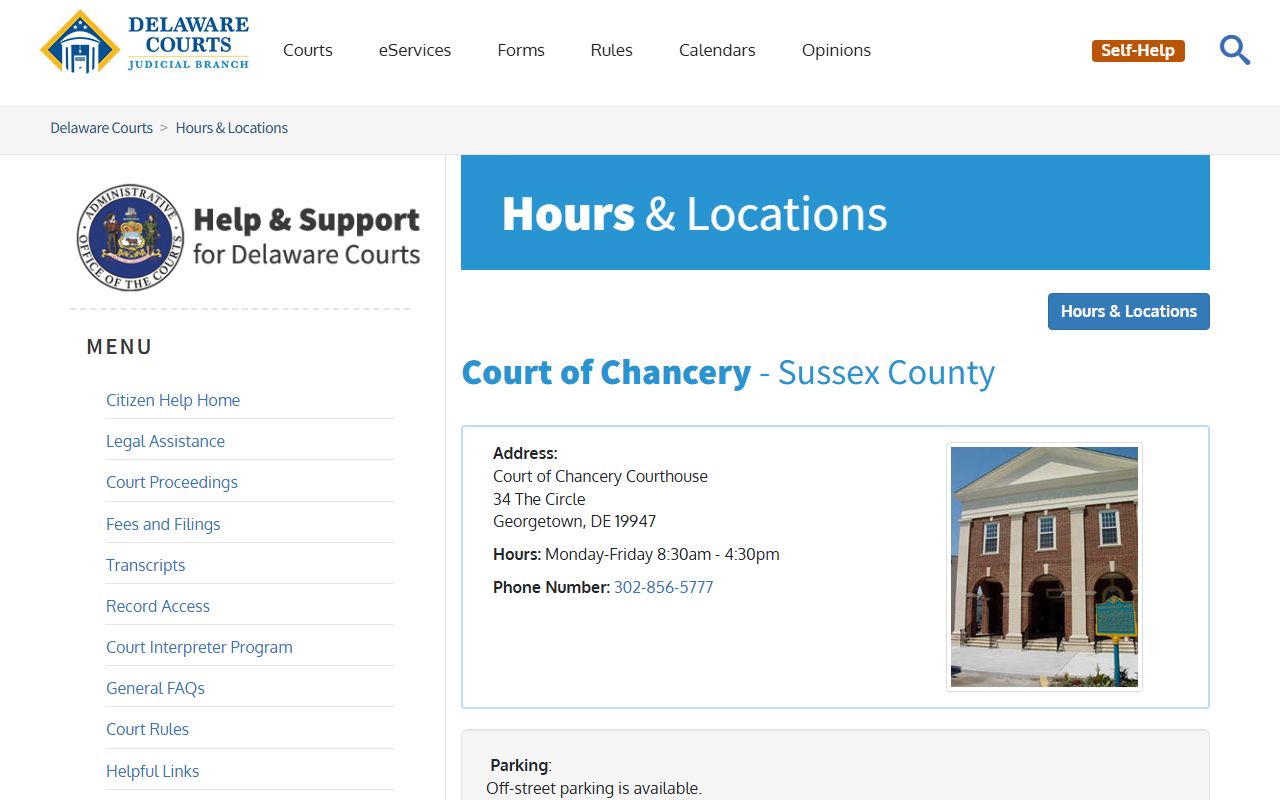
The Chancery location page is useful for a fiduciary or trustee whose work crosses from estate administration into the equity court for a contested matter.
For broader probate framework, see the probate records page.