
About the Sussex County Register of Wills
The Register of Wills is a county office, not a court. The current Register for Sussex is Gregory Fuller. The office is staffed by Chief Deputy Kristine Vavala and Deputy Alison Emerson, along with administrative staff who run intake, scheduling, and copy requests. The office is in the Sussex County Courthouse Annex at 5 E. Pine St. in Georgetown, a short walk from the main county courthouse and from the Family Court building.
The office administers estates being probated in Sussex County, grants authority to personal representatives, and makes sure each administration follows Delaware law. The office files wills, opens estates, issues short certificates, accepts inventories and accountings, and closes estates when the personal representative has finished the work. Routine appointments are required to open or close a probated estate, to handle an ancillary estate, or to deposit a will for safekeeping.
Sussex County Register of Wills
Register: Gregory Fuller
5 E. Pine St., PO Box 743
Georgetown, DE 19947
302-855-7875
Fax: 302-853-5871
Hours: Monday to Friday, 8:30 a.m. to 4:30 p.m.
Building locks at 4 p.m.; office closes to the public at 3 p.m. on the last Monday of the month.
Sussex County Estate Terms Defined
Estate paperwork uses a small set of standard terms. Knowing what each one means saves time on the phone and at the office counter.
- Testator
- The person who made the will. A testator dies "testate."
- Executor
- The person named in the will to carry out its terms. The executor is the personal representative for a testate estate.
- Administrator
- A personal representative appointed for an estate when there is no executor named or able to serve.
- Personal representative
- The general term for the person the Register authorizes to act for the estate, whether executor or administrator.
- Intestate
- Dying without a valid will. Delaware law sets out who inherits and who can be appointed to administer the estate.
- Short certificate
- The Register's document that proves the personal representative's authority. Banks, insurers, and transfer agents ask for short certificates before releasing assets.
- Letters testamentary
- Court papers granting the executor authority under a will. Often issued together with short certificates.
- Inventory
- A signed list of estate assets and values as of the date of death. Required within three months after grant of letters.
- Accounting
- A signed report of the receipts, disbursements, and final distributions of the estate. Required within one year after grant of letters.
How to Open an Estate in Sussex County
The Register of Wills runs the estate opening by appointment. A walk-in may be worked around scheduled appointments, but the office prefers a scheduled visit. Before the call, gather the original will and a certified death certificate. Bring photo identification. The Register opens the estate, swears in the personal representative, and issues short certificates to allow estate business to move forward.
- Deliver the original will to the Register within ten days after receiving notice of the maker's death. Delaware law sets that ten-day duty on a person who possesses an original will.
- Call 302-855-7875 to schedule the opening. Bring the original will and a certified death certificate. Have a list of likely heirs and a rough sense of assets if possible.
- If the will is not self-proved, the office may need witnesses to verify signatures. Handwriting witnesses or disinterested individuals may be needed when original witnesses are not available.
- If no next of kin or relatives administer within 60 days from death, the Register may appoint an interested person as administrator.
- Receive short certificates at the opening. Pay the $15 inventory fee at opening. Take the certificates to banks and other holders of estate assets.
- File the inventory within three months after grant of letters. The inventory lists assets and values as of the date of death.
- File the accounting within one year of grant of letters. Pay closing costs at the close. The closing cost is 1.25 percent of the net personal estate, plus $20 for recording and indexing, plus $5 per release filed.
Note: The building locks at 4 p.m., and the office closes to the public at 3 p.m. on the last Monday of the month, so plan appointments with care.
Sussex County Estate Records Search
Estate searches at the Register are not done by email. A reader who emails a decedent name and asks staff to look in the files gets a reply that points back to the Estate Search Request Form. The form is the official channel for searches. Filling it out correctly is the fastest way to get a search result.
- Gather the decedent name, the date of death if known, and the county of domicile at death. Delaware law sends a will to the Register in the county where the decedent lived.
- Request the Sussex Register of Wills Estate Search Request Form by phone at 302-855-7875 or in person at 5 E. Pine St., Georgetown.
- Fill out the form, sign it, and submit it by the method the form lists.
- Pay any required search or copy fees. The office can confirm the fee at intake.
- Wait for the response. The office can confirm whether an estate file exists and can provide copies of public estate filings.
- For a contested fiduciary, trust, or guardianship matter, the matter likely sits with the Court of Chancery rather than the Register.
Sussex Register of Wills Fees
The fees below come from the Register's published probate steps. The Register also publishes a fuller fee schedule for items not listed here. Closing costs scale with the net personal estate, so a small estate has a small closing cost and a larger estate has a larger closing cost.
| Item | Amount |
|---|---|
| Inventory filing | $15, collected at opening |
| Closing cost on net personal estate | 1.25% of net personal estate |
| Recording and indexing at closing | $20 |
| Per release filed at closing | $5 |
| Affidavit (no Delaware estate or inheritance tax due, relevant older periods) | $10 |
| Opening fee | See Register's Various Fees page |
Delaware estate law is set out in 12 Del. C. Chapter 1 for wills and Chapter 15 for Register of Wills authority and estate administration. The full Title 12 lives at the Delaware Code Title 12 index.
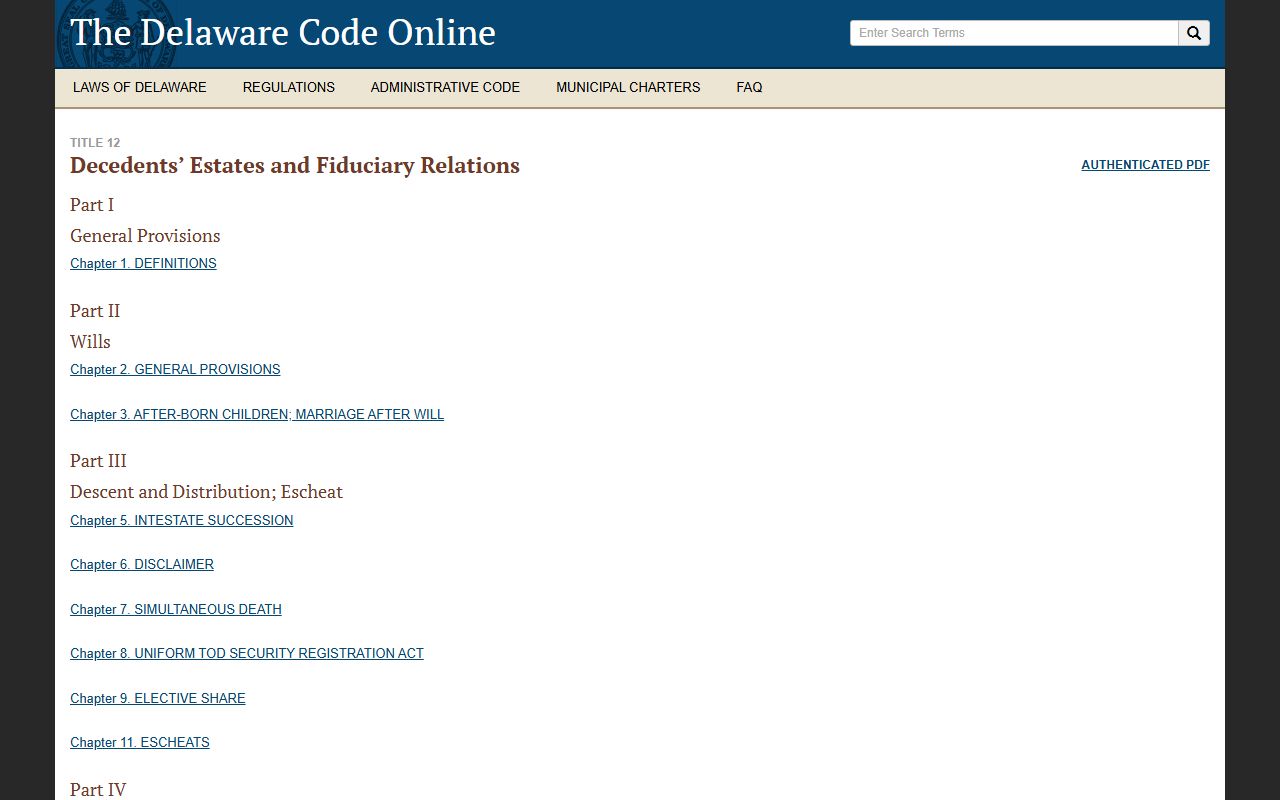
A read through Title 12 helps personal representatives understand what the Register expects at each stage.
Filing a Will in Sussex County
Delaware law requires a will to be filed with the Register of Wills in the county where the decedent was domiciled. A person who holds the original will has a duty to deliver it to the Register within ten days after receiving notice of the maker's death. The duty applies whether the holder is family, an attorney, a friend, or a safe-deposit box co-signer. Failure to deliver the will can lead to follow-up action by the office.
A "self-proved" will has a notarized affidavit from the testator and the witnesses. A self-proved will moves through the office without separate witness verification. A will that is not self-proved may need witnesses to come to the office to verify signatures. If the witnesses are not available, handwriting witnesses or disinterested individuals may be needed. The Register's intake call covers what proof is needed for the will the office has.
A will can be deposited for safekeeping during the testator's lifetime. The deposit is an appointment-only service, so call the office first. The Register holds the will and releases it to the named executor when the time comes.
Chancery and Other Office Overlap
The Register handles routine estate administration. Contested fiduciary work, trust questions, guardianships, and most equity matters move to the Court of Chancery. The Sussex Chancery courthouse is at 34 The Circle in Georgetown. The Register and Chancery work from the same body of estate law but handle different sides of the work. A reader who has a routine opening goes to the Register; a reader who has a fight over a trustee or a request to remove a fiduciary may end up in Chancery.
The Recorder of Deeds is a separate office and does not record wills. The Recorder of Deeds handles deeds, mortgages, easements, and other recorded land documents. The Marriage Bureau handles marriage licenses and certified copies of marriage records, also through a different county office. The Prothonotary handles Superior Court civil and criminal filings; see the Prothonotary page for that work.
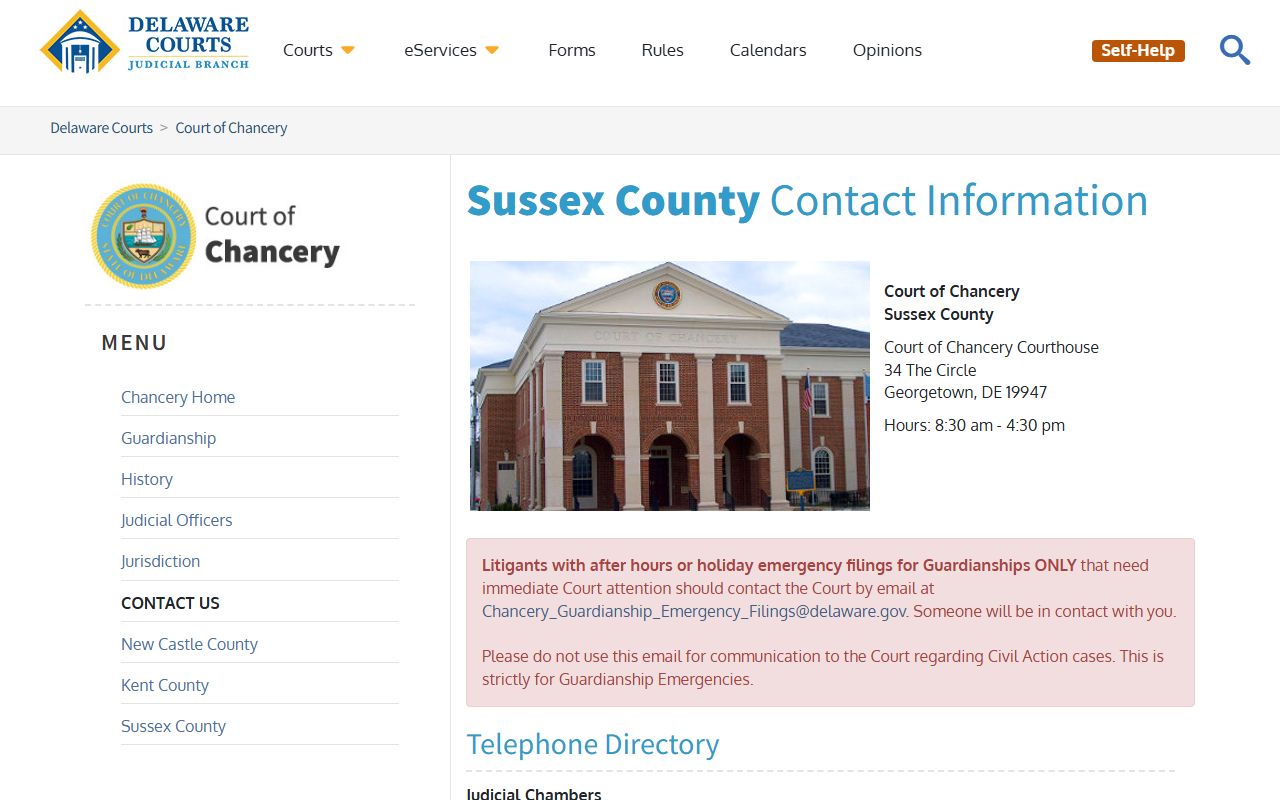
The Chancery directory page lists the deputies who handle guardianship, trust, and fiduciary matters that route to the equity court.
Visiting the Sussex Register's Office
The Sussex Register of Wills sits in the Courthouse Annex at 5 E. Pine St., not in the main Sussex County Courthouse on The Circle. The office is around the corner from the main courthouse and a short walk from the Marriage Bureau and the Recorder of Deeds at 2 The Circle. The office holds full hours Monday to Friday, 8:30 a.m. to 4:30 p.m., with the building locking at 4 p.m. The last Monday of the month brings an earlier public-counter close at 3 p.m.
Parking near the office is the same Georgetown courthouse parking pattern: a small lot on East Pine and South Race Streets, metered spaces near the buildings, and non-metered spaces farther down the streets toward Union Cemetery. Plan for a short walk and for security at the main courthouse if an estate visit needs both offices on the same day.
The Court of Chancery's Sussex location page covers the Chancery side of the work for readers who have a guardianship or trust matter that ties into the estate. The page is hosted at the Delaware Courts site.
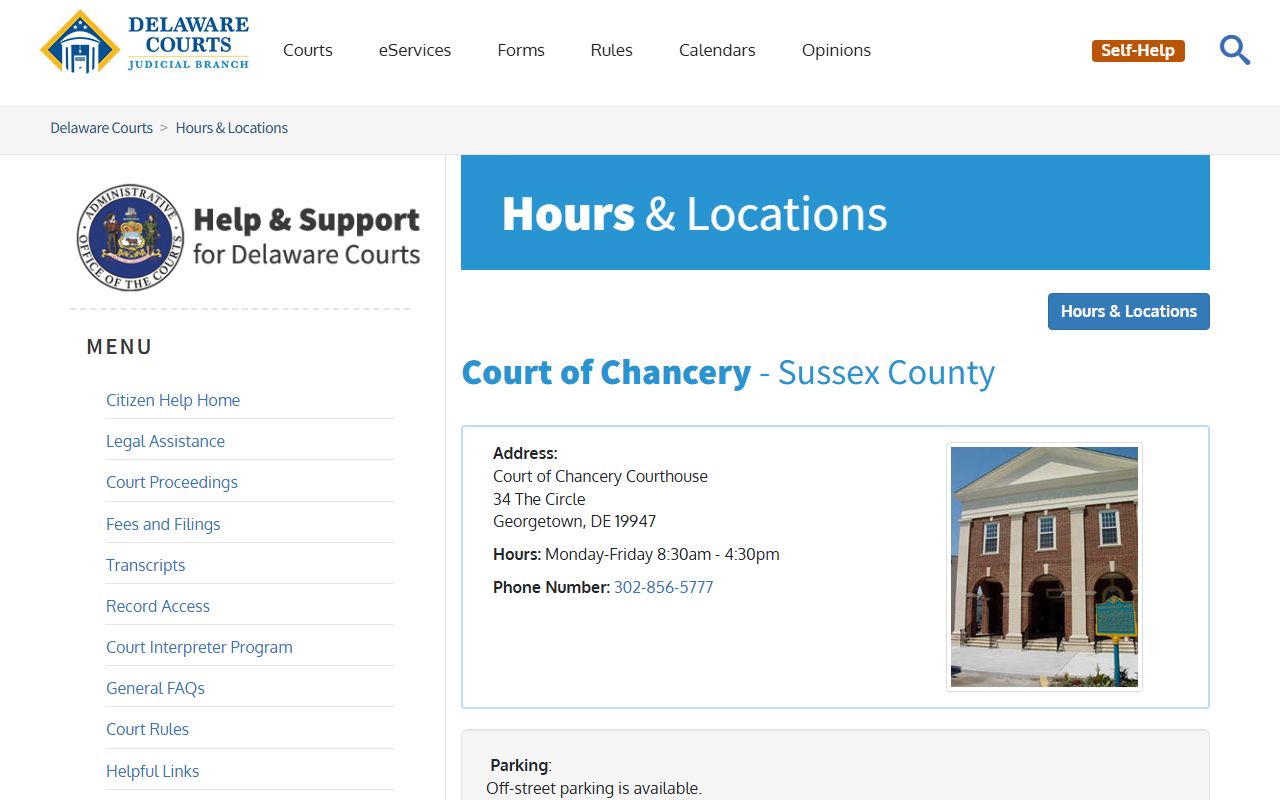
Reading the Chancery location page before a first appearance helps a fiduciary or a trustee understand the building and the basic check-in process.