
How to Search Sussex County Court Records
Court case lookups for Sussex County start at Delaware CourtConnect, the State of Delaware Courts Judicial Case Database. CourtConnect is a statewide portal, not a county system. The landing page offers three paths: search by person name, business name, or case type; search for judgments against a person or business; and a docket report when the case ID is already known. Sussex Superior, Common Pleas, JP, Family, and Chancery cases all flow into the same index, with results filtered by court and case type code.
The portal is for case and docket data only. The Delaware Judiciary disclaimer says CourtConnect data is provided as is, with no warranty of accuracy or timeliness, and is not for official use. The CourtConnect page that hosts the search forms also gives helpful context.
A view of the entry point sits at the CourtConnect main index on the Delaware Courts site.
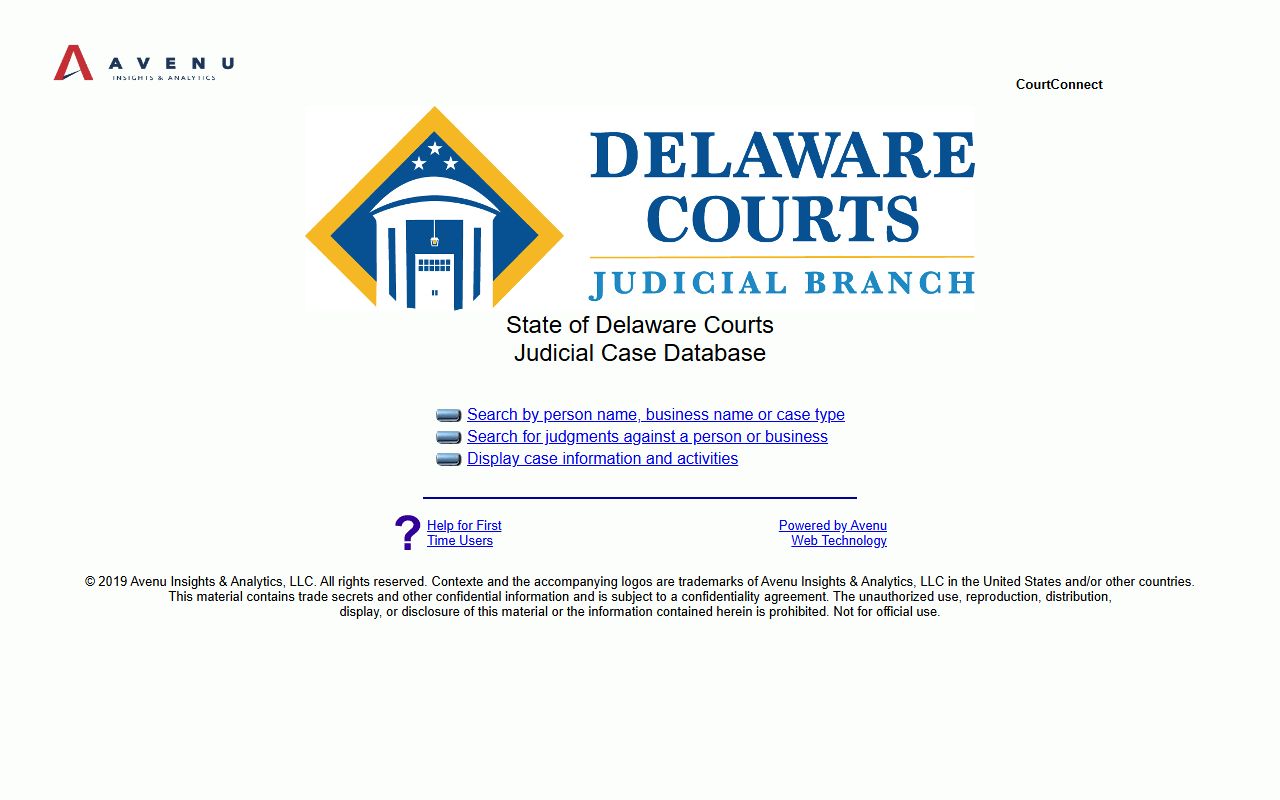
The three search paths on this landing page route to separate forms, with the person and case type search being the most common starting point for a name lookup.
Before opening the portal, gather any case ID, the full legal names involved, a likely filing year, and a sense of which court heard the matter. JP debt and landlord-tenant cases sit under codes 60 and 61. Superior civil complaints appear under 3C. Name changes show up under 4N. Chancery guardianships fall under 2G. Knowing the code narrows results, but a broad search on last name with no code is often the safest first step.
- Open CourtConnect and read the disclaimer about non-official use. Pick the person, business, or case type search if no case ID is in hand.
- Enter the last name or company name. Add first or middle name if known. Check partial last name or phonetic search when spelling may vary.
- Leave case type set to ALL on a first pass. Narrow by court type code after seeing initial matches.
- Add a beginning and ending case filing date if the filing window is roughly known. The date format is DD-MON-YYYY, for example 01-JAN-2026.
- Submit and review the result list for case ID, court, parties, and case type.
- For a docket report on a known case, return to CourtConnect and run the docket form with the exact case ID.
- For certified copies or sealed-file questions, contact the clerk that holds the file, such as the Prothonotary for Superior Court or Family Court records for divorce matters.
A direct look at the person and case type search form is on the CourtConnect name search page.
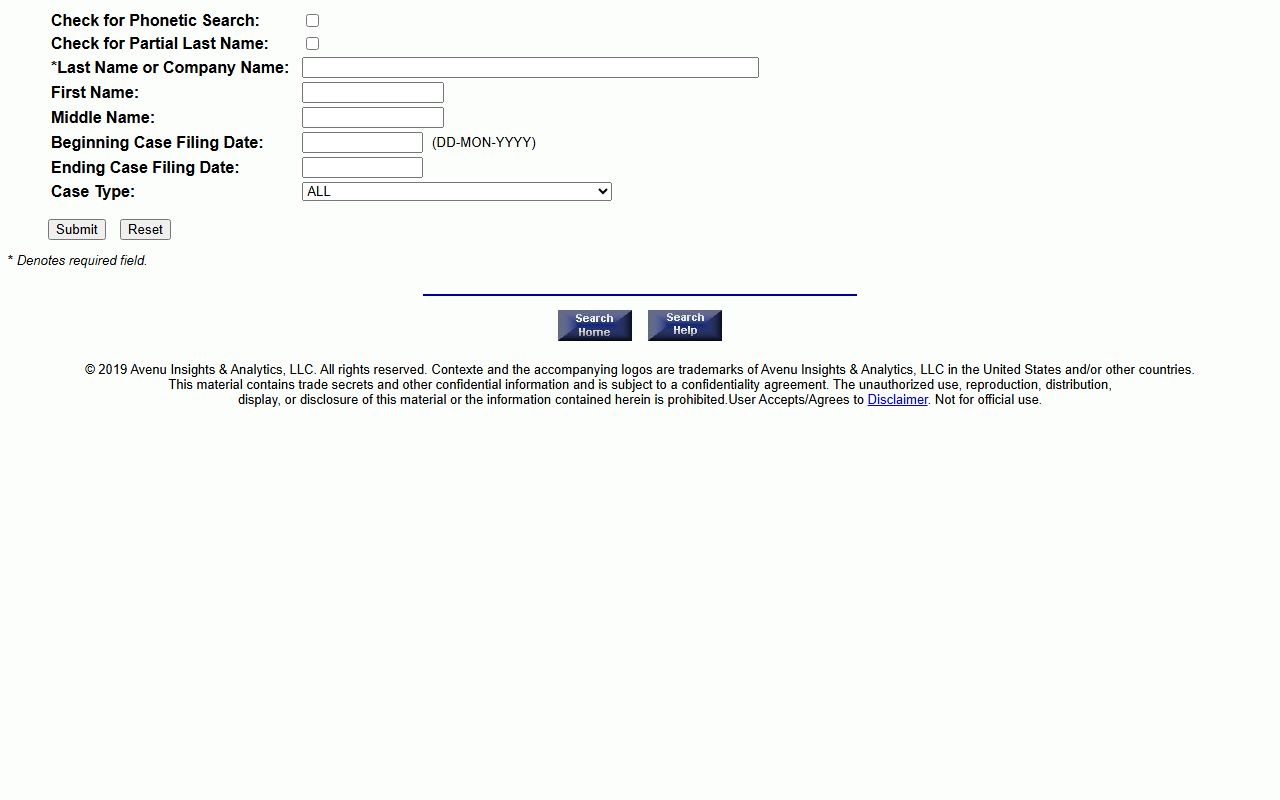
The form requires a last name or company name, with first name, middle name, date range, and case type as optional filters.
Field-by-field, the search form lays out like this:
| Field | Type | Required | Notes |
|---|---|---|---|
| Phonetic Search | Checkbox | No | Pulls sound-alike names. |
| Partial Last Name | Checkbox | No | Allows truncated last or company name. |
| Last Name or Company Name | Text | Yes | Max 60 characters. |
| First Name | Text | No | Max 15 characters. |
| Middle Name | Text | No | Max 15 characters. |
| Beginning Case Filing Date | Date | No | Format DD-MON-YYYY. |
| Ending Case Filing Date | Date | No | Same format. |
| Case Type | Dropdown | No | Defaults to ALL. Long list of court and case codes. |
The Sussex County Judicial System
Delaware court structure is statewide and unified. The Delaware Judiciary overview explains that the Supreme Court sits at the top, with the Court of Chancery, Superior Court, Family Court, Court of Common Pleas, and Justice of the Peace Court below. Sussex County hosts a branch of each trial court, with most of the work centered on Georgetown. A traffic citation may begin at a JP Court; a misdemeanor often moves through Common Pleas; a felony runs through Superior Court; family and juvenile matters go to Family Court; trusts, guardianships, and corporate equity disputes sit with Chancery.
The Judiciary overview page outlines this structure for the entire state.
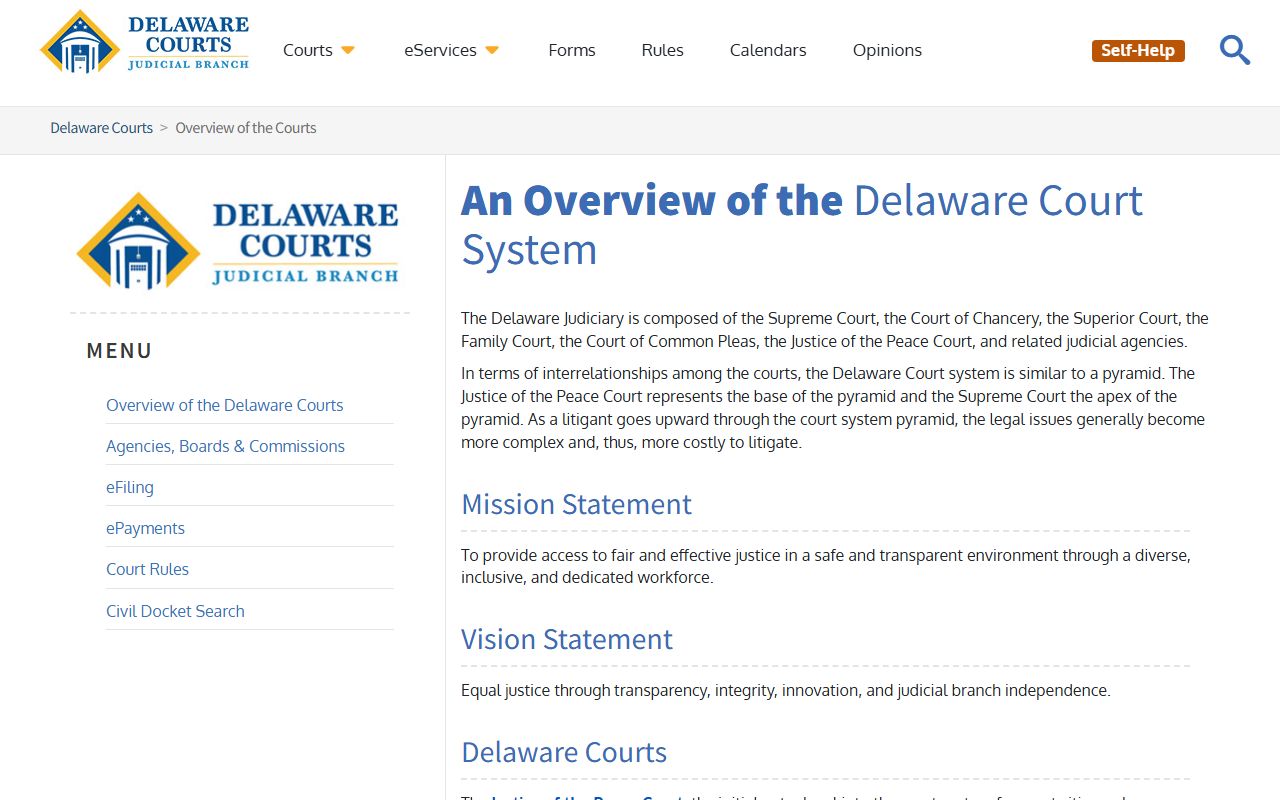
The same overview lists appeal paths: JP appeals go to Common Pleas, Common Pleas appeals go to Superior Court, and Superior or Chancery final orders go up to the Supreme Court.
Case flow: Justice of the Peace Court › Court of Common Pleas › Superior Court › Supreme Court of Delaware
A snapshot of the Sussex court locations index is published by the Judiciary at the Sussex court locations page.
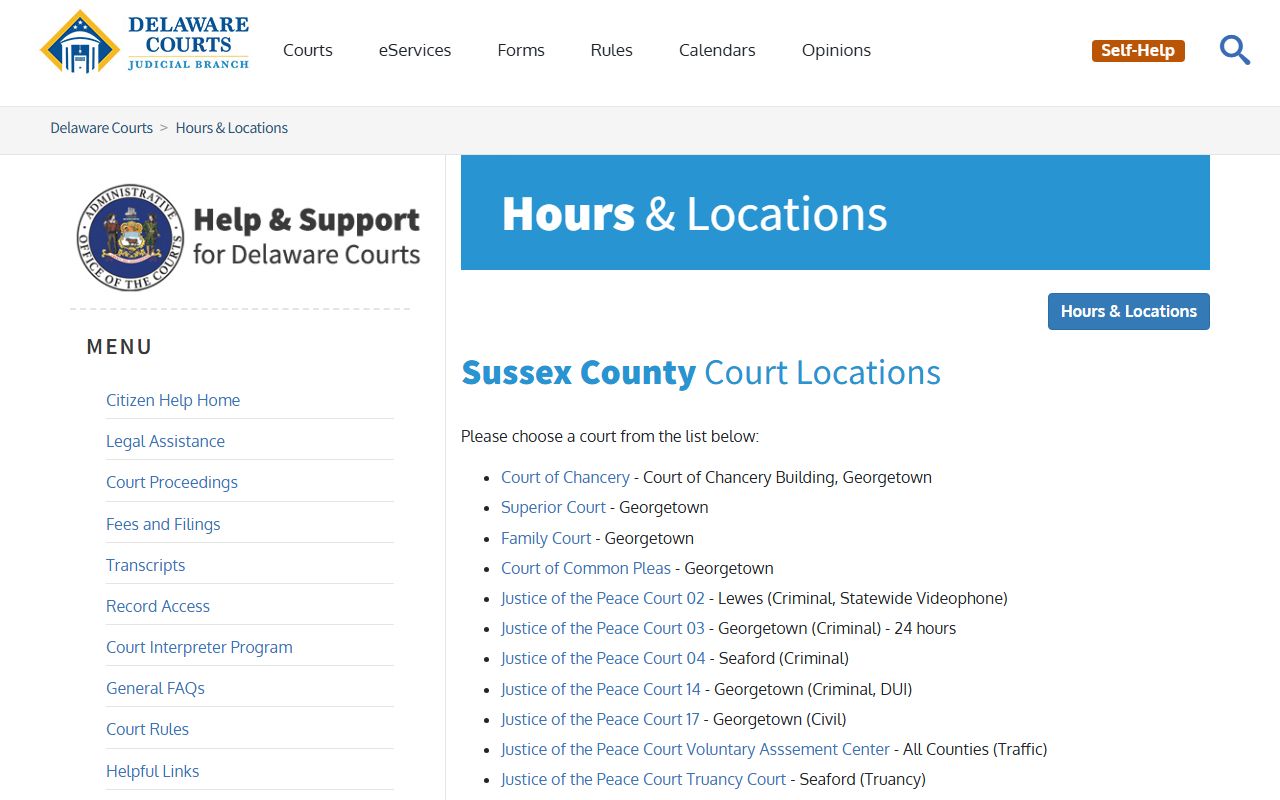
The page lists every Sussex trial court address, phone, and hours in one directory, which is the fastest way to confirm a court before a visit.
| Court | Jurisdiction | Case Types |
|---|---|---|
| Supreme Court of Delaware | Final appeals | Appeals from Chancery, Superior, and Family Court civil and juvenile matters. |
| Court of Chancery | Equity | Corporate disputes, trusts, estates, guardianships, fiduciary matters, title to land. |
| Superior Court | General trial | Felonies, all drug offenses, civil cases with no monetary cap, agency appeals. |
| Court of Common Pleas | Mid-level trial | Misdemeanors, civil claims up to $75,000, felony preliminary hearings. |
| Family Court | Family and juvenile | Divorce, custody, support, juvenile delinquency, adoption, protection orders. |
| Justice of the Peace Court | Entry level | Civil under $25,000, landlord tenant, traffic, minor crime, truancy. |
For a side-by-side view of the three trial courts Sussex residents see most often:
| Topic | Superior Court | Court of Common Pleas | JP Court |
|---|---|---|---|
| Felony jurisdiction | Yes, exclusive | Preliminary hearings only | Committing magistrate only |
| Civil cap | None | $75,000 | $25,000 |
| Misdemeanor | Some | Most | Limited types |
| Landlord tenant | No | No | Yes |
| Appeal path | To Supreme Court | To Superior Court | To Common Pleas |
Note: Delaware has no county district court or county at law, and the phrase district court only refers to the federal District of Delaware in this state.
Types of Sussex County Court Records
Sussex court files cover almost every kind of dispute or charge that state law touches. Civil cases include Superior Court complaints, Chancery equity actions, Common Pleas matters up to $75,000, and JP civil cases under $25,000. Documents in these files may include the complaint, answer, motions, orders, judgments, liens, writs, and the docket itself. CourtConnect case codes show debt, breach of contract, replevin, landlord tenant, trespass, consumer debt, mechanics lien, mortgage, condemnation, foreign judgment, personal injury, property damage, products liability, and broad mass-tort groups.
Criminal cases route by severity. JP Courts handle minor criminal and most traffic matters. Common Pleas hears misdemeanors except some drug and traffic charges, plus felony preliminary hearings. Superior Court holds exclusive jurisdiction over felonies and almost all drug offenses. A criminal record may include charging papers, indictment or information, bail decisions, arraignment, plea, sentencing orders, and any capias entries. Public criminal-history dissemination is separate from court files and is run by the State Bureau of Identification under Title 11, Chapter 85.
- Civil records spread across Superior Court, Chancery, Common Pleas, and JP Court, sorted by amount in controversy and subject matter.
- Criminal records live in the court that handled the charge, with felonies in Superior Court and most misdemeanors in Common Pleas or JP Court.
- Family records sit with the Family Court records room and include divorce, custody, support, protection from abuse, and juvenile delinquency files.
- Probate records are kept by the Register of Wills, with contested fiduciary or trust questions routed to Chancery.
- Traffic records begin at JP Court or the Voluntary Assessment Center, with serious traffic cases moving up to Common Pleas or Superior Court.
Eviction, name change, protective order, mental health commitment, and judgment lien matters all also generate court records. CourtConnect lists judgments from Chancery, Superior civil, Common Pleas, JP Court, Family Court, foreign judgments, hospital liens, property tax monitions, and Division of Revenue actions. The judgments index is one of the most useful tools for confirming whether a debt or lien has been entered against a person or business.
What Sussex County Court Records Show
A Sussex County court record is more than a verdict line. Each file builds up over time through filings, hearings, orders, and financial entries. CourtConnect dockets surface the core fields, while certified copies from the clerk show the underlying documents. Some fields are public on the docket. Some are redacted under court rule. Some sit in the paper file at the clerk counter and only show up on a records request.
| Field | What It Shows |
|---|---|
| Case ID | The unique number used to pull a docket report. Required when running CourtConnect by case number. |
| Court and County | Which Delaware court holds the file, such as Superior Court Sussex or JP Court 3 Georgetown. |
| Case Type Code | Coded category such as 3C for Superior civil complaint, 4A for debt, or 61 for JP landlord tenant. |
| Parties | Plaintiff and defendant, petitioner and respondent, state and defendant, or estate and personal representative. |
| Filing Date | Date the matter was opened with the court. |
| Docket Activities | Each filing, order, hearing, motion, writ, continuance, judgment, or capias. |
| Disposition | The outcome of the case or a charge, such as dismissed, judgment entered, plea entered, or sentence imposed. |
| Financials | Fines, costs, judgments, liens, restitution, bond, or estate fees. |
| Redactions | Social security numbers, financial account numbers, medical and juvenile information, sealed material. |
For a docket-level view, CourtConnect runs a docket report form with case ID and optional date range. The form is short.
The form lives at the CourtConnect docket report page.
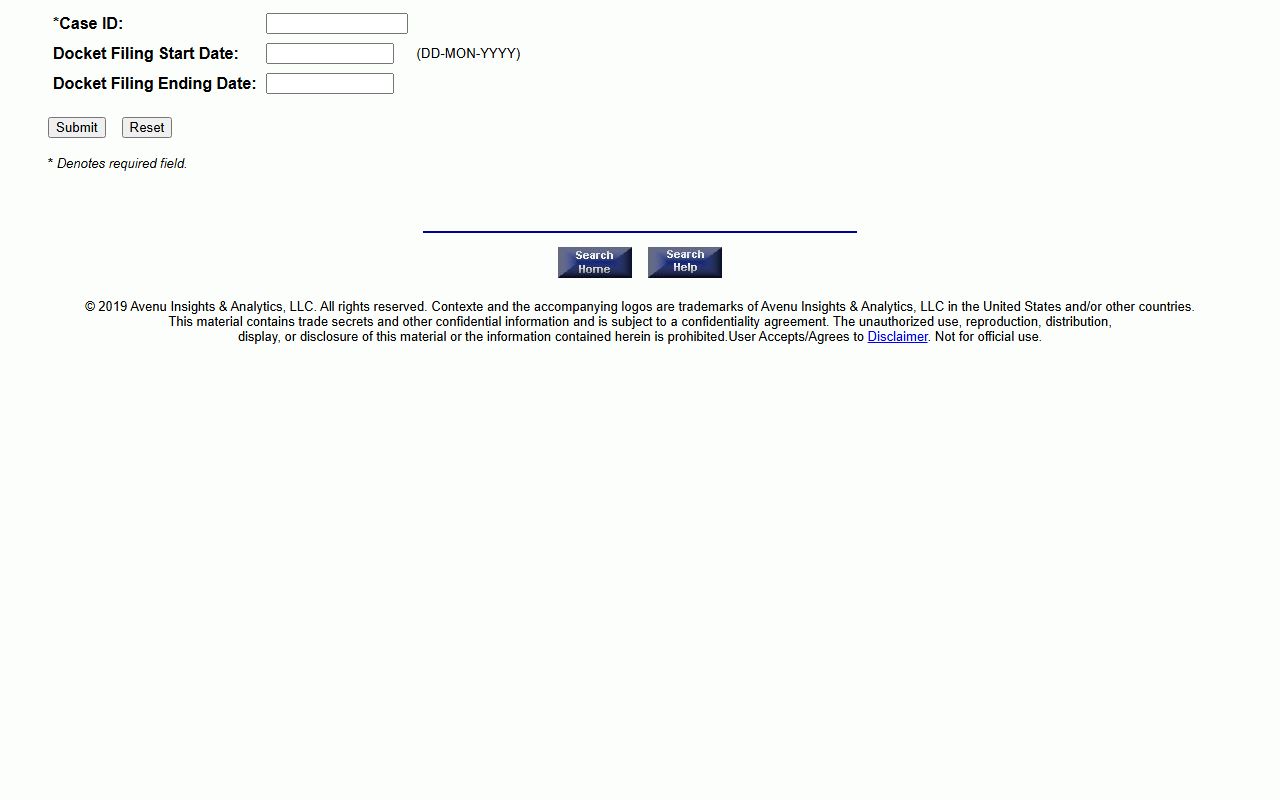
Once submitted, the report lists docket activities tied to that case ID, which is the closest a free public portal gets to the courtroom event list.
Public Access Laws for Sussex County Court Records
Delaware treats public records and court records as two related but distinct buckets. County departments fall under the state Freedom of Information Act, codified in Title 29, Chapter 100. State court files run under separate judiciary rules and confidentiality statutes. The county FOIA page tells readers that Sussex is bound by 29 Del. C. Ch. 100 and the local FOIA policy, while court case data flows through CourtConnect and clerk record rooms. Records are presumed accessible unless a statute, court rule, privacy protection, or exemption applies.
The Judiciary itself flags this on its public case search, hosted at the Delaware civil case search page.
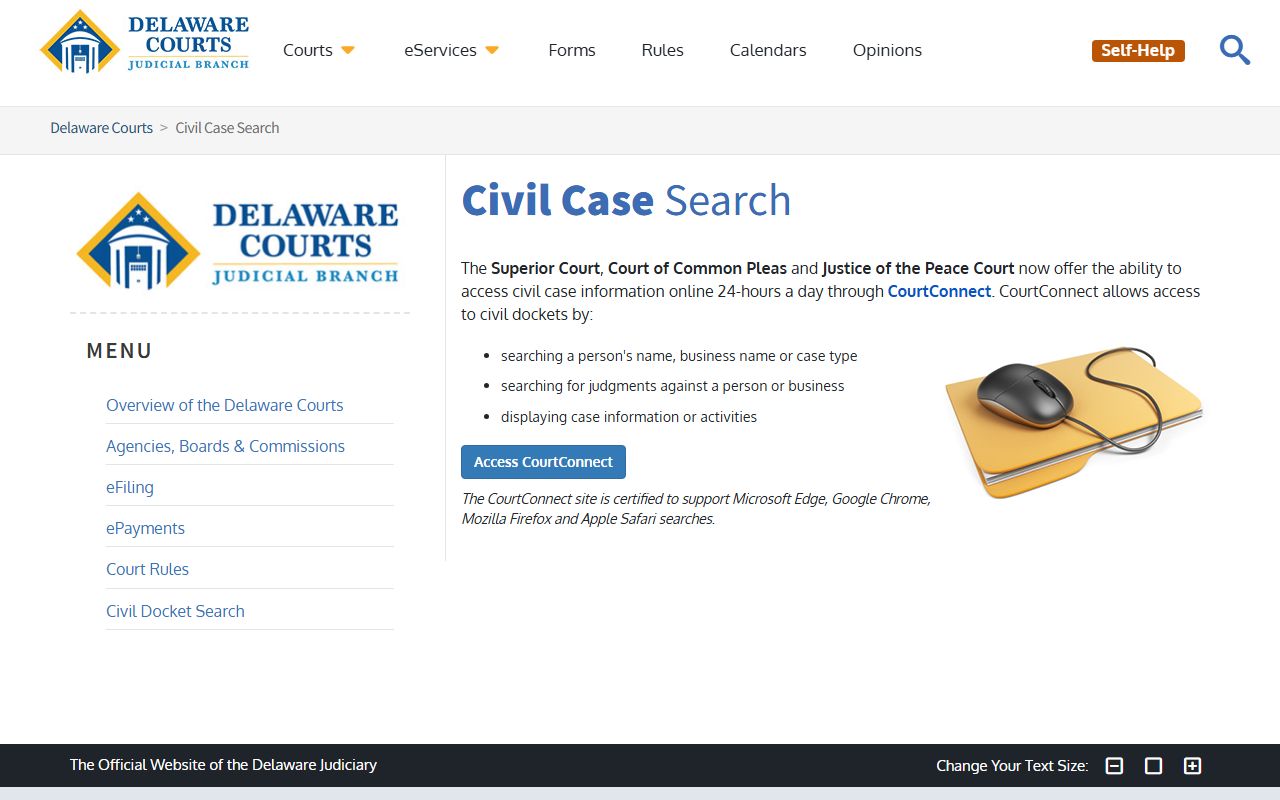
The page routes users to CourtConnect for docket data and to the appropriate clerk for certified copies and sealed-file questions.
Key Delaware statutes:
29 Del. C. § 10001 sets the policy that public business should be open and citizens should have easy access to public records.
29 Del. C. § 10002 defines public record and lists FOIA exemptions, including investigatory files, personnel and medical files, child custody, and adoption records.
29 Del. C. § 10003 sets the inspection and copying process, requiring public bodies to give reasonable assistance during regular business hours.
11 Del. C. Ch. 85 governs the State Bureau of Identification, which controls official criminal history record dissemination.
13 Del. C. Ch. 1 covers marriage license and solemnization law, while 13 Del. C. Ch. 15 governs divorce and annulment. Probate sits under 12 Del. C. with rules for wills, estate administration, and Register of Wills authority.
The CourtConnect disclaimer is a separate, important rule. It says the data is provided as is, with no warranty of correctness or timeliness, that the civil docket report is not for official use, and that email or internet communication through the portal does not count as filing or legal notice. The notice is preserved on the Judiciary site.
The full text sits at the CourtConnect disclaimer page.
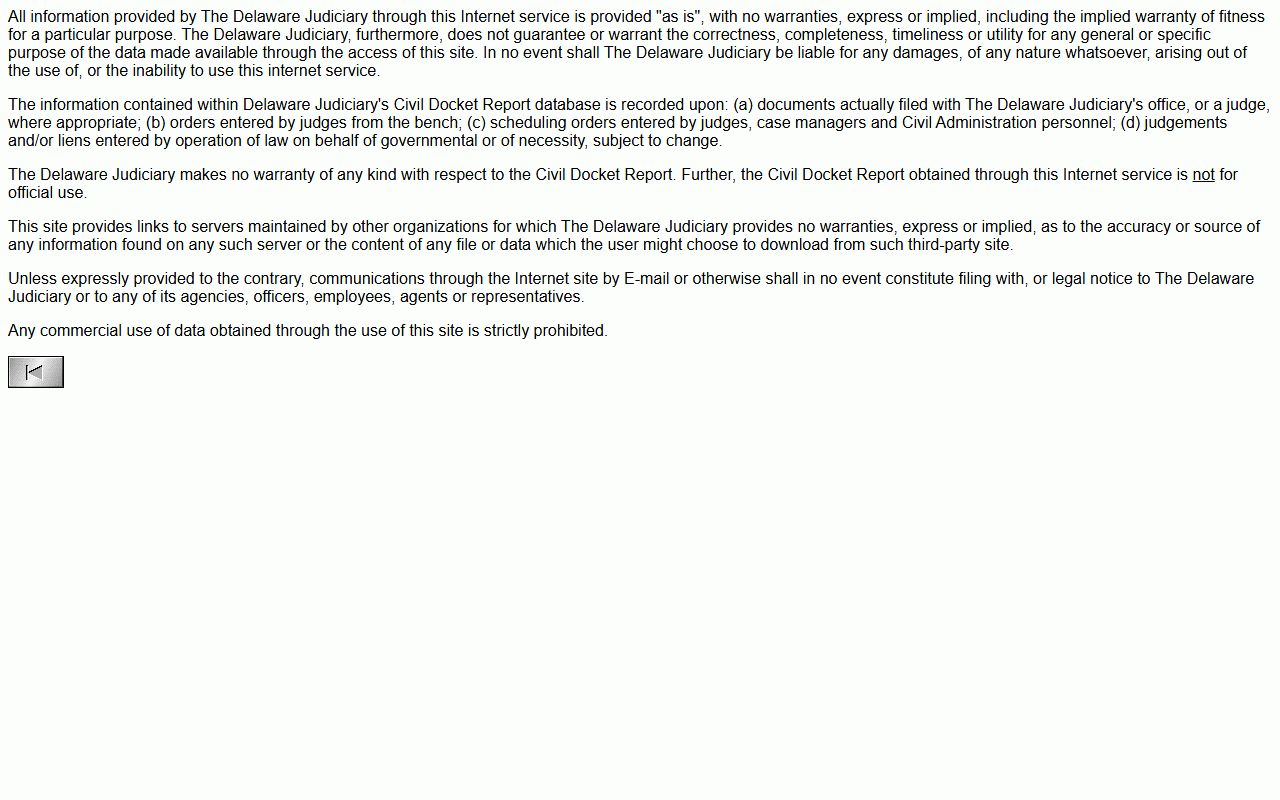
Anyone using CourtConnect for legal work should pair the docket view with a certified copy from the originating clerk.
Records That Are Restricted or Confidential
Not every Sussex court record is open. Juvenile delinquency and dependency files in Family Court are restricted, with access limited to parties, counsel, agencies, or by court order. Juvenile expungement runs under Title 10, Chapter 9, Subchapter III. Adoption and child custody files are pulled out of routine public access by FOIA section 10002, which carves out child custody and adoption files where no criminal complaint is at issue. Family Court privacy policy adds another layer at the records counter, where any in-person review of a Family Court file must happen with staff present.
Sealed and expunged criminal records sit behind their own wall. The Delaware Courts expungement page routes petitions by court. If a case ended in Common Pleas or Justice of the Peace Court, the petition goes to the Prothonotary in Superior Court. Family Court has its own adult and juvenile expungement packets. The Office of Defense Services warns that clearing a record is not a one-step process and that Delaware criminal histories are not casually destroyed. Mental-health or involuntary commitment proceedings, grand jury material, active investigatory files, and trade-secret information also stay out of the public docket view.
Note: A record that is not posted online is not always public, and a sealed or expunged record may still exist for limited statutory uses inside the court or police system.
Specialty Courts in Sussex County
Delaware runs problem-solving dockets inside its regular trial courts rather than as separate buildings. The Court of Common Pleas hosts a Drug Diversion Program for non-violent offenders and a DUI Court, both of which can route eligible defendants away from a standard criminal sentence and into supervised treatment. Drug Diversion focuses on treatment, drug testing, and judicial oversight; DUI Court combines monitoring with sentencing tied to alcohol education and treatment.
Family Court runs its own internal units in every county. Sussex Family Court has Intake Services, Diversion Services, Special Court Services, and Caseflow Management. These units handle protection-from-abuse intake, juvenile diversion, mediation, parenting classes, and case scheduling. Remote-hearing options exist for many family matters. The Delaware Courts navigation also lists a statewide Community Court under the Administrative Office of the Courts, though that program is not Sussex-specific.
Sussex County Sheriff and Sussex Correctional Institution
Sussex County does not run a jail. Delaware uses a unified state correctional system, and the Delaware Department of Correction says every prison and institution falls under state jurisdiction. The Sussex County Sheriff's Office, led by Sheriff Robert Lee, serves court papers and runs sheriff sales for tax foreclosures, mortgage foreclosures, and other court orders. The office mailing address is PO Box 948, Georgetown, DE 19947, with the main line at 302-855-7830. The Sheriff page also carries a public warning about scam callers who impersonate deputies; the office says it will never ask for money over the phone.
Custody data lives with the state. Delaware DOC's Locate an Inmate page directs the public to VINELink, which allows custody status searches and notification signup by phone, email, text, or TTY. Sussex Correctional Institution in Georgetown is the local DOC facility. SCI opened in 1931, houses an all-male population at maximum, medium, and minimum security, and has official capacity statements in the range of 1,109 to 1,206 beds after the 1997 to 2000 expansion. Full inmate-roster questions, visitation rules, mail, and money deposits run through DOC procedures, not the Sheriff. For more, see the Sussex County inmate records page and the warrant records page.
Marriage, Divorce, and Probate in Sussex County
Marriage, divorce, and estate matters in Sussex County run through three separate offices rather than a single probate court. The Sussex County Marriage Bureau, part of the Clerk of the Peace office and led by Norman A. Jones Jr., issues marriage licenses, holds Memorable Marriage ceremonies, and provides certified copies of licenses issued in Sussex County. It is appointment only. Divorce and annulment fall under Family Court, which sits at 100 East Market Street in Georgetown and runs the family records room with staff supervision. The Register of Wills, with Gregory Fuller as Register, handles estate openings, will filings, inventories, accountings, and closings. Court of Chancery in Georgetown handles trusts, fiduciary disputes, and guardianships. See the marriage and divorce records page and the probate records page for office-by-office detail.
- Prothonotary
- The Superior Court civil clerk in Delaware, kept on the second floor of the Sussex County Courthouse in Room 214.
- Register of Wills
- The county office that admits wills to probate, opens estates, issues short certificates, and supervises personal representatives.
- Clerk of the Peace
- The county office that issues marriage licenses and officiates marriage ceremonies under Title 13.
- Recorder of Deeds
- The Sussex County office that records deeds, mortgages, and other land instruments. Led by Alexandra Reed Baker.
- Testator
- The person who makes a will. A Delaware will must be delivered to the Register of Wills within ten days of notice of death.
- Executor
- The personal representative named in a will to administer the estate.
- Short Certificate
- The Register of Wills document that proves a personal representative has authority to act for the estate.
Sussex County Court Records Fees
Fees are set office by office in Delaware, with court copy fees on the Judiciary side and probate and recording fees on the county side. The Register of Wills publishes the clearest small-dollar schedule on its probate steps page. Court of Common Pleas, Justice of the Peace Court, and Superior Court fees vary by service and are published through the Delaware Courts forms and fees pages. Sussex County FOIA fees are set under the county FOIA policy and 29 Del. C. Ch. 100. Always confirm the current amount before mailing a check.
| Item | Amount |
|---|---|
| Probate inventory filing (Register of Wills) | $15, collected at opening |
| Closing cost on a probate estate | 1.25% of net personal estate |
| Recording and indexing on estate close | $20 |
| Release filing per release | $5 |
| Affidavit no Delaware estate or inheritance tax (certain periods) | $10 |
| Court copy and certified copy fees | Set by Delaware Courts fee schedule, confirm with clerk |
| Sussex County FOIA copy fees | Set under county FOIA policy |
Note: Marriage license fees are not posted in detail on the Marriage Bureau main page, so call 302-853-1717 before scheduling a license appointment.
How to Interpret Sussex County Court Records
Reading a Delaware docket starts with the case ID and the case type code. The code reveals the court and category. 3C is a Superior civil complaint. 4A is debt in Common Pleas. 61 is a JP landlord tenant case. 4N is a name change petition. 2G is a Chancery guardianship. M6 is a civil contempt or capias. Knowing the code helps explain which clerk holds the file and which appeal route applies. The parties line lists plaintiff and defendant, petitioner and respondent, or state and defendant. The docket activity log lists every filing, order, hearing, and judgment in order of date.
Charges are not convictions. An arrest charge can be dismissed, reduced, or merged at any point in the case. A disposition entry tells the rest of the story: dismissed with prejudice means the case generally cannot be refiled; dismissed without prejudice means it can be refiled; nolle prosequi means the prosecutor dropped the charge; a guilty plea or verdict followed by a sentence shows the conviction. Common docket abbreviations include CAP for capias, FTA for failure to appear, ROR for release on recognizance, NCC for new case caption, and SAT for satisfaction of judgment. A definition list of common legal terms is in the Sussex County Court Records FAQ for fuller explanations.
Accuracy and Record Limitations
CourtConnect data is built from filings, judge orders, scheduling entries, and judgments entered by operation of law. The Judiciary disclaimer warns that data is subject to change and is not warranted for timeliness. A docket entry made today may not show on the public portal until the clerk processes the filing. A sealed order may close off public view of an entire case. A pending case may show up before any disposition is entered. None of that means the record is wrong. It means the public view is a snapshot, and a certified copy from the originating clerk is the official source.
Errors do happen and the correct route to fix them runs through the court that holds the file. Misspelled names, wrong date of birth, missing disposition entries, or duplicated cases should be raised with the Prothonotary, the Family Court records room, the Register in Chancery, or the relevant JP Court depending on case type. Old paper-era cases may not appear on CourtConnect at all and have to be pulled from the clerk's stored files.
Note: Always confirm court details with the originating clerk before relying on a CourtConnect screen for a job, license, lease, or legal filing.
History of Sussex County Courts
Sussex County's court history is tied to Georgetown's Circle. Superior Court and Court of Common Pleas now occupy 1 The Circle. Court of Chancery sits at 34 The Circle. The Marriage Bureau and County Administrative Offices share 2 The Circle. The Register of Wills works out of the Courthouse Annex at 5 East Pine Street. That clustering reflects the long role Georgetown has played as county seat. Delaware court history runs deeper than the buildings: the Court of Chancery is nationally known for corporate and equity work, Superior Court is the general jurisdiction trial court, and the Court of Common Pleas became a constitutional court in 2005 after its statewide statutory creation in 1973.
Recent milestones are easy to track. Family Court Sussex moved into a new 100 East Market Street building, with a time capsule placed in 2025 during construction. Court of Common Pleas welcomed Judge Gerard M. Spadaccini for a first term in September 2025. CourtConnect runs on Avenu Web Technology with interface updates through the late 2010s. Justice of the Peace Court 3 in Georgetown moved to a 6 a.m. to midnight schedule under a 2026 staffing pilot and does not accept new cases after 11 p.m. The Circle has stayed the same; the workflow around it keeps changing.
Sussex County Courthouse Location and Contact
The Sussex County Courthouse on The Circle is the main state-court hub for Superior Court and the Court of Common Pleas. Chancery sits a block away. Family Court is its own building on East Market Street. The Register of Wills works out of the courthouse annex on East Pine Street. Each office has its own phone, hours, and entry rules.
Superior Court of Sussex County
1 The Circle, Suite 2
Georgetown, DE 19947
302-855-7055
Monday to Friday 8:00 a.m. to 4:30 p.m.
Court of Common Pleas, Sussex
1 The Circle, Suite 1
Georgetown, DE 19947
302-858-5700
Monday to Friday 8:30 a.m. to 4:30 p.m.
Court of Chancery, Sussex
34 The Circle
Georgetown, DE 19947
302-856-5777
Monday to Friday 8:30 a.m. to 4:30 p.m.
Family Court, Sussex
100 East Market Street
Georgetown, DE 19947
302-855-7400
Monday to Friday 8:30 a.m. to 4:30 p.m.
Self-Help and Legal Aid in Sussex County
Self-help options sit alongside the official courts. The Delaware Courts Self-Help section covers legal assistance, court proceedings, fees and filings, transcripts, record access, the interpreter program, general FAQs, and rules. The Delaware Courts forms library hosts expungement, Family Court, Common Pleas, JP, and court-specific packets. The Sussex County Law Library, located in the Family Court Courthouse at 100 East Market Street, is open to the public; law librarian Margaret L. Naylor staffs the room and asks callers to phone 302-856-5483 ahead of a visit because of staffing limits.
Legal-aid options include the Office of Defense Services for indigent criminal defense, the Delaware Department of Justice Victim and Witness Assistance Program at 302-752-3263 for Sussex County, and Community Legal Aid Society for civil legal aid at 302-856-0038 in Georgetown. The Family Court Domestic Violence Advocacy Center for Sussex can be reached at 302-856-5843. For traffic citation issues, Court of Common Pleas provides a Restoration of Driving Privileges packet and Pay Traffic Ticket service. For sealing or expungement, see the Delaware Courts expungement page and the Office of Defense Services expungement resources. Pro se filers should expect appointments, supervised file review, and case-specific forms in nearly every Sussex office.
Frequently Asked Questions
Where do I search Sussex County court records online?
Use Delaware CourtConnect, the State of Delaware Courts Judicial Case Database. It is statewide, not county-run. Search by person, business, or case type when no case number is known, or use the docket report when the case ID is in hand. Data on CourtConnect is provided as is and is not for official use, so a certified copy from the clerk is still needed for any legal purpose. Sussex Superior, Common Pleas, JP, Family, and Chancery cases all show in the same portal once the right case type code is set.
Does Sussex County have a District Court?
No local trial court named District Court exists in Delaware. Superior Court is the general-jurisdiction trial court, with exclusive jurisdiction over felonies and almost all drug offenses, and no monetary cap on civil damages. Below Superior Court sit the Court of Common Pleas, Justice of the Peace Court, Family Court, and Court of Chancery. The phrase district court in Delaware only refers to the federal U.S. District Court for the District of Delaware, which sits in Wilmington and uses PACER for case access.
Where is Superior Court in Sussex County?
Superior Court for Sussex County is inside the Sussex County Courthouse at 1 The Circle, Suite 2, Georgetown, DE 19947. Court hours run Monday to Friday 8:00 a.m. to 4:30 p.m., with public access starting at 8:30 a.m. The main line is 302-855-7055, the fax is 302-856-5739, and TDD is 302-856-5895. The Prothonotary, who is the Superior Court civil clerk, works in Room 214 on the second floor. A small courthouse lot sits at East Pine and South Race Streets.
How soon must a will be filed in Sussex County?
Delaware law requires a person who possesses an original will to deliver it to the Register of Wills within ten days after receiving notice of the maker's death. The Sussex Register of Wills office is in the Courthouse Annex at 5 East Pine Street, with phone 302-855-7875. To open an estate, bring the original will and a certified death certificate. The office requires appointments for opening, closing, and depositing a will for safekeeping. Walk-ins are worked around scheduled appointments.
Does the Sussex County Sheriff run a jail?
No. Delaware uses a unified state correctional system. The Sussex County Sheriff's Office serves court papers and runs sheriff sales for tax foreclosures, mortgage foreclosures, and other court orders. Inmate custody information for people held in Delaware DOC facilities runs through VINELink. Sussex Correctional Institution in Georgetown is a state DOC facility, not a county jail. The Sheriff's Office page also carries a scam warning: the office will never ask for money over the phone, and any such call should be treated as fraud.
Is there a public warrant search for Sussex County?
No official Sussex County public warrant portal exists. CourtConnect does list civil contempt and capias case types tied to court orders, but criminal warrants may stay sealed before arrest. Anyone who thinks a warrant has been issued should contact the court that may have issued it, such as JP Court for traffic or minor crime, Court of Common Pleas for misdemeanors, Superior Court for felonies, or Family Court for protection or family matters. Speaking to a defense attorney before contacting a court is often the safer route.
Where do federal cases from Sussex County go?
Federal civil and criminal cases from Sussex County go to the U.S. District Court for the District of Delaware in Wilmington. Bankruptcy cases go to the U.S. Bankruptcy Court for the District of Delaware. Both use PACER and CM/ECF for case access and filings. Federal inmate searches use the federal Bureau of Prisons inmate locator rather than Delaware DOC or VINELink. Federal appeals usually go to the U.S. Court of Appeals for the Third Circuit, with some specialized appeals routed to the Federal Circuit depending on issue.
How do I file a FOIA request for Sussex County records?
Sussex County FOIA requests can be filed online through the MyCustHelp portal, by PDF form emailed to casey.hall@sussexcountyde.gov, by fax to 302-855-7749, by mail to PO Box 589 ATTN Casey Hall in Georgetown, or in person at 2 The Circle. The FOIA coordinator routes the request to the right county department. Court records are not handled by county FOIA; those run through Delaware Judiciary policy and clerk procedures. Many routine items can be answered without a formal FOIA submission by contacting the relevant office first.
More on the Sussex County Court Records FAQ page.